What Does It Take to Add $1M in New Pipeline in a Single Quarter in 2027?
By Bhushan Raj ShakyaSEO Specialist
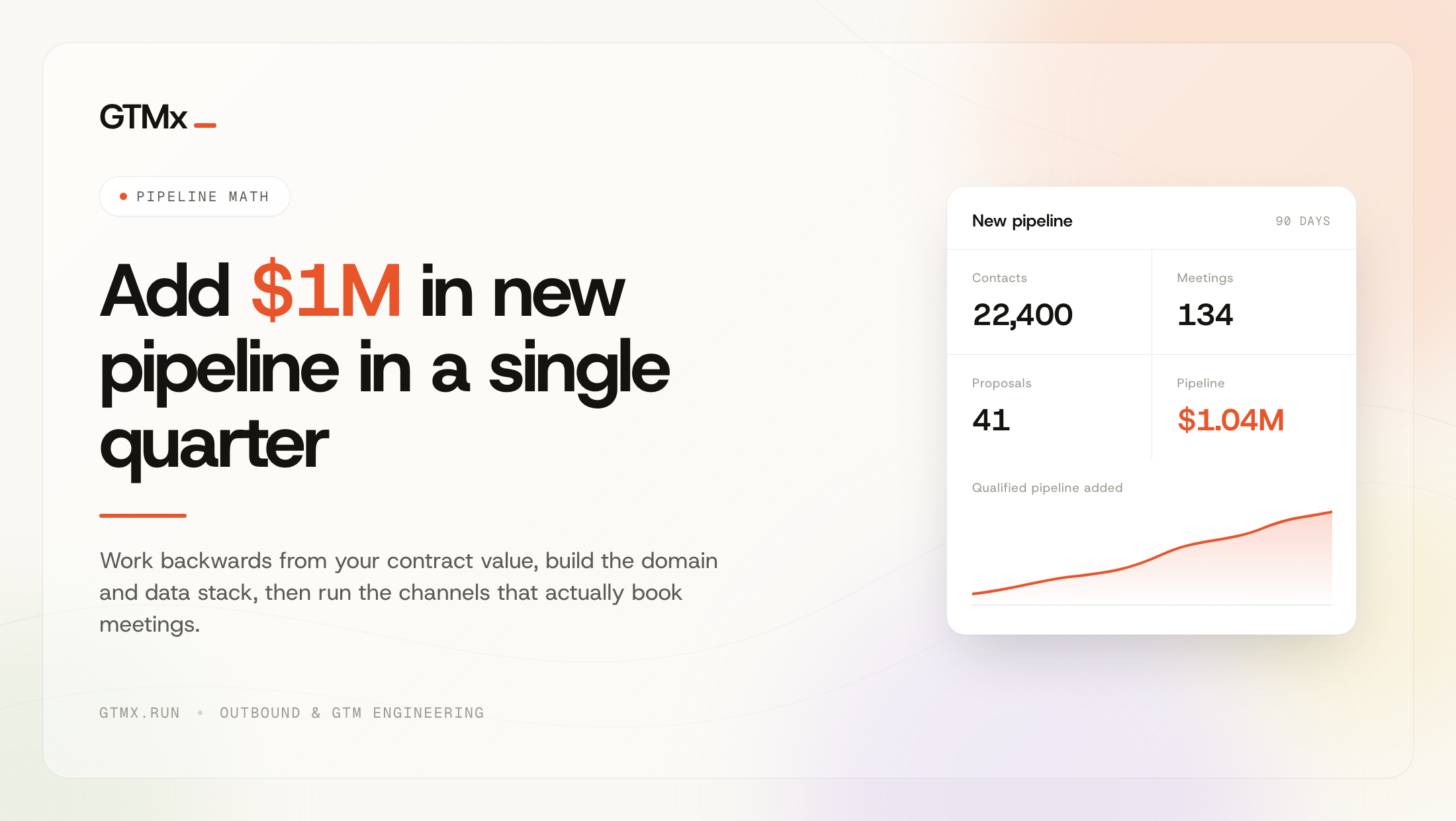
To add $1M in pipeline in 90 days, work backwards from your contract value. At a $50,000 average contract value, $1M of pipeline is 20 qualified opportunities, which takes roughly 48 qualified meetings and thousands of contacts. This guide shows the math, the sending infrastructure and the channels.
TL;DR To add $1M in pipeline in 90 days, work backwards from your contract value. At a $50,000 average contract value, $1M of pipeline is 20 qualified opportunities, which takes roughly 48 qualified meetings and thousands of contacts. This guide shows the math, the sending infrastructure and the channels.
Waiting for inbound leads will not add $1M in pipeline fast enough for your sales team. You must build a targeted outbound system that turns raw data into booked meetings. This guide explains how to work out the math, set up the domains and launch your campaigns.
Key takeaways
- Work backwards from your average contract value to find your exact contact volume.
- Set up pre-warmed secondary domains with strict authentication records to protect your main site.
- Use dynamic data tools to find intent signals and verify your contacts.
- Mix cold email, social touches and phone calls to book more meetings.
- Keep your user-reported spam rates strictly below 0.10 percent.
- Track how many meetings turn into real proposals instead of checking open rates.
What is the exact math to add $1M in pipeline?
Pipeline is the total contract value of qualified opportunities created in a period. It is not closed revenue. Work backwards from your deal size to the number of contacts you must reach, and treat every conversion rate below as an input you replace with your own CRM data.
What is your target average contract value?
Your average contract value (ACV) sets the size of the job. At a $50,000 ACV, $1M of new pipeline is 20 qualified opportunities.
How many qualified meetings create 20 opportunities?
Not every qualified meeting becomes an opportunity. As a worked example, assume 42% do, which is the SQL-to-opportunity rate First Page Sage reports for B2B SaaS. Twenty opportunities then need about 48 qualified meetings (20 divided by 0.42).
How many prospects do you need to contact?
The contacts you need depend on your meeting rate per contact. GTMx's working rules are a reply rate of at least 2%, with 20% to 25% of replies positive, and roughly 1 in 3 positive replies turning into a meeting (GTMx aims for 1 in 2). That funnel gives about 0.13% to 0.25% meetings per contact, so 48 meetings needs roughly 19,000 to 36,000 contacts. GTMx's OpenSponsorship case study reported 40+ sales-qualified leads from 2,321 contacts, a far higher rate, so test with a pilot before you commit to volume.
| Meetings booked per contact | Contacts needed for 48 meetings (arithmetic) |
|---|---|
| 0.13% | 36,000 |
| 0.25% | 19,200 |
| 0.5% | 9,600 |
| 1.0% | 4,800 |
What changes if you want $1M in closed revenue?
Closed revenue needs far more pipeline. At a $50,000 ACV you need 20 closed deals. Ebsta x Pavilion's 2025 GTM Benchmarks put the median new-business win rate at 19%, so 20 wins takes about 106 opportunities (20 divided by 0.19), roughly 253 qualified meetings at a 42% progression rate, and about 5.3 times the revenue target in pipeline (1 divided by 0.19). Plan the quarter around the pipeline target, and expect most of the revenue to close in a later quarter.
How do you calculate your target market size?
Your first step is checking your total addressable market against your required contact volume. Ensure enough good accounts exist to sustain a 90-day sprint.
What is the formula for a 90-day sprint?
Use a simple formula to find your daily volume. Take your pipeline target, divide by deal size, then divide by your meeting-to-opportunity rate and your meetings-per-contact rate. For a closed-revenue target, also divide by your win rate.
If you lack past data, use conservative industry benchmarks. Testing this formula ensures your quarterly pipeline generation targets remain grounded in reality. Setting accurate goals prevents early burnout.
How do you assess addressable market limits?
GTMx requires B2B companies to have a market above 20,000 accounts for effective outbound. Trying to scale rapidly will fail if your niche is too small.
You will burn through your database before your pipeline matures into real revenue. You need a large pool to keep going without repeating contacts. Broad markets sustain high volume.
Why should you target the full buying committee?
When single target accounts are rare, speak to several leaders in the same business. Ebsta's 2025 benchmarks link earlier decision-maker involvement to higher win rates.
Speaking to the full buying committee improves your B2B sales pipeline velocity, because group consensus wins deals.
How do you build your outbound technical infrastructure?
Sending tens of thousands of messages safely requires separate technical systems. You must build isolated sending domains and set up strict sending rules to protect your brand.
What domain infrastructure do I need for cold outreach?
You need secondary domains that redirect to your primary website, with three inboxes per domain. GTMx can have pre-warmed secondary inboxes live in 72 hours because it sources pre-warmed inboxes from vendors. A brand-new domain that starts cold takes about 30 days, including 2 to 4 weeks of warm-up. Every domain carries SPF, DKIM and DMARC records, which protects your main domain from penalties.
How do you configure authentication correctly?
Bulk senders must authenticate domains with SPF, DKIM and DMARC to meet 2026 Google sender guidelines. You must also add RFC 8058 one-click unsubscribe links to keep deliverability high.
Turning off open tracking can help. In its Vidify case study, GTMx improved deliverability by removing open tracking and cutting images and HTML from the emails. Hunter's 2026 report on 31 million emails found sequences without open tracking averaged a 7.4% reply rate against 4.4% with tracking.
How should you pace automated warmup schedules?
New domains cannot send thousands of emails at once without triggering spam filters. You must use tools like Smartlead or Instantly to run automated warmup cycles safely over several weeks.
These platforms manage your mailboxes and slowly increase daily sending limits. This builds the solid domain reputation you need to succeed. Patience protects your domain.
What are safe daily sending limits?
GTMx caps cold sending at 15 emails a day per Google inbox and 10 per Microsoft inbox, with three inboxes per secondary domain. Each inbox also spends its first three months on probation, so GTMx stays conservative. At 15 emails a day per inbox, sending 1,000 emails a day takes about 67 inboxes, which is about 23 domains (arithmetic).
Spreading required volume across dozens of mailboxes keeps individual limits low. This approach ensures your messages actually get delivered to target buyers.
Step 3: Source and Enrich Account Data
Bought lists rarely convert well enough to build your pipeline quickly. You must use dynamic data workflows to spot real buying signals and check contact details accurately.
Finding intent with dynamic waterfall enrichment
Clay has moved modern outbound to dynamic waterfall enrichment. It chains several data providers in sequence and stops once one returns a verified contact.
This ensures you only message valid addresses, keeping bounce rates exceptionally low. Low bounce rates protect your long-term domain health and keep outreach active throughout the entire 90-day pipeline sprint.
Detecting signals with native AI web-scraping agents
Relying on job titles alone is too slow for a rapid quarterly sprint. You must use native AI web-scraping agents to spot hiring triggers or tech stack changes.
Sorting accounts based on real intent signals boosts positive reply rates. You stop wasting time on people not ready to buy and focus entirely on active buyers.
Syncing enriched data directly to your CRM
Your data tool must connect to your main CRM system to work efficiently. You need API-governed, bi-directional syncing into HubSpot or Salesforce to stop data duplication.
This automated routing ensures leads are scored properly and ready for immediate outreach. You remove manual data entry from your sales process entirely. Automation accelerates your pipeline.
How do you orchestrate channels to add $1M in pipeline?
Single-channel outreach will not add $1M in pipeline on its own. You must layer email, social touches and phone calls to boost your final conversion rates.
How different outbound channels perform
| Channel | Primary Role | Velocity | Best Used For |
|---|---|---|---|
| Cold Email | Opens the door | High | Broad market testing and initial pitches |
| Builds familiarity | Medium | Professional networking and social proof | |
| Warm Calling | Books the meeting | Immediate | Converting engaged prospects into scheduled calls |
| Multi-Channel | Orchestrates all touches | Highest | Reaching the full buying committee |
Choose multi-channel outbound if you want to know how to build B2B pipeline fast. Choose a single channel only for strict compliance setups.
Spreading your effort across multiple touchpoints yields the best conversion rates. Layering your outreach builds immense trust with careful buyers.
Opening the door with human-written email
Cold email remains the most cost-effective way to test your core message. You must always use a human-written email and edit it for absolute clarity.
GTMx adheres to a strict maximum of 70 to 75 words for human-written copy. using AI to build your first outbound pipeline assists with research, but humans must write the final draft.
Building trust through personal LinkedIn outreach
LinkedIn does not publish an official weekly invitation cap, and practitioners commonly observe about 100 connection requests per week. You must fix your personal profile before you launch your LinkedIn outreach sequence.
Liking posts and sending direct messages builds trust before you ask for a meeting. Familiarity drives higher positive reply rates because people buy from credible professionals.
Securing meetings with same-day warm calls
The phone is where most meetings get booked, provided you only call people who have already engaged. Triggering same-day warm calls based on email opens yields better conversion than blind cold calling.
These timely calls qualify the prospect well during the conversation. They secure time on your calendar right away to accelerate your deal cycles.
Launch Your Multi-Channel Engine
We can build this system for you. GTMx can have pre-warmed secondary sending inboxes live in 72 hours, builds waterfall lists in Clay, and runs human-written campaigns.
See How Automated Outbound Adds Same-Day Warm Calls To Anyone Who Engages. →
Optimize and Iterate Your Weekly Campaigns
Launching is only the start of your growth effort. You must constantly check your reply data, fix your messages and refine your targeting to hit your goals.
Testing new copy variants every week
You should test different subject lines and calls to action across your audience. Weekly testing lets you drop bad messages quickly and scale the clear winners immediately.
GTMx believes you must learn from real replies, not six weeks of planning. Testing drives your success rate higher over time by constantly refining your core market pitch.
Managing replies and booking sales meetings
Fast follow-up is critical when a prospect shows interest in your offer. You must have a system to handle replies, clear up doubts and send calendar links right away.
Delays in response time will cost you valuable meetings. They will also ruin your outbound pipeline targets for the quarter by letting warm prospects go entirely cold.
Identifying the right triggers for each industry
Different sectors need entirely different approaches to copy and targeting. If you sell to B2B SaaS companies, focus heavily on tech stack changes rather than generic pain points.
Commercial cleaning outreach requires targeting building managers who screen emails heavily. You must use completely distinct angles for every niche to prove you understand their daily world.
How do you safely scale without spamming?
Technical rule changes have made old outreach tactics completely useless today. You must respect rigid spam complaint ceilings and regional data laws to keep your domains safe.
Staying below Google spam complaint ceilings
Google enforces a strict user-reported spam complaint ceiling of 0.30 percent for all bulk senders. Going over this limit results in fast domain downgrades and delayed inbox placement.
You must aim to keep your daily complaint rate safely below 0.10 percent. This careful monitoring ensures consistent delivery for your fast 90-day sprint without risking a sudden block.
Monitoring Google Postmaster Tools telemetry
Google Postmaster Tools accurately tracks messages sent to personal Gmail inboxes that are marked as spam. It provides vital details on your IP reputation, domain health and setup success.
Checking these technical dashboards daily is mandatory for any serious automated outbound team. You cannot ignore this hard data if you want to keep your infrastructure fully operational.
Following UK PECR rules for B2B lists
Sending an unsolicited B2B email to corporate subscribers is legally allowed under UK PECR without prior consent. You must clearly state your business name and provide a simple opt-out link.
Processing the related personal data still requires a documented Legitimate Interests Assessment under the UK GDPR. Always review these policies with legal counsel to ensure total compliance.
Navigating complex European privacy laws safely
Outbound rules change drastically across different European borders. Germany strictly bans unsolicited electronic commercial communications without prior express opt-in consent under its UWG rules.
You must split your audience by country and adjust your approach to remain fully compliant. Always seek a formal legal review for your specific target regions before launching campaigns outside your home jurisdiction.
Measure Pipeline Velocity and Revenue Impact
Checking vanity metrics will distract you from your real revenue goals during a sprint. You must strictly track metrics that tie to closed deals and active pipeline progression.
Tracking opportunity progression rates closely
The 42% progression rate in the math above is an example, not a promise. Replace it with your own rate for how many qualified meetings become formal opportunities, and review it every month.
You must track how many first meetings reach a formal proposal stage. If your rate drops, your targeting criteria need immediate fixing.
Calculating your cost per qualified meeting
Your tool stack and labour costs dictate the financial health of your pipeline. GTMx's blog puts typical first-pipeline tooling costs under $1,000 a month.
Dividing total software and labour costs by booked meetings reveals your true cost per qualified meeting. This metric shows actual customer acquisition efficiency and proves your outbound system is profitable.
Reviewing the shared live dashboard
Revenue leaders need clear visibility into daily campaign numbers and overall speed. You should build a shared live dashboard tracking daily replies, meeting volumes and total attributed pipeline value.
A custom CRM build provides this absolute transparency without needing manual reports. You can easily spot problems early, keeping sales and marketing teams perfectly aligned.
10 steps to launch your pipeline sprint
- Define your average contract value and deal volume.
- Work out your target opportunity win rate.
- Map your total addressable market in Clay.
- Buy and configure secondary sending domains.
- Set up SPF, DKIM and DMARC records.
- Run automated warmup cycles safely.
- Write human-led copy under 75 words.
- Sync enriched lead lists to your CRM.
- Launch email, social touches and warm calls.
- Check Google Postmaster daily for spam complaints.
Map Your Outbound Strategy
Stop guessing where your next quarter of growth will come from.
Frequently asked questions
How many secondary domains and mailboxes do I need for cold outreach?
It depends on your daily volume. GTMx caps cold sending at 15 emails a day per Google inbox and 10 per Microsoft inbox, with three inboxes per secondary domain. To send 1,000 emails a day on Google inboxes you need about 67 inboxes, which is about 23 domains (arithmetic). Spreading volume this way keeps every inbox within safe limits.
What cold email reply rate can B2B SaaS companies realiztically expect?
Published benchmarks put average cold email reply rates at about 3.4% to 4.5% (Instantly and Hunter, 2026), and definitions vary. GTMx's published case studies show reply rates from 1.0% to 3.2%, and GTMx sets a minimum target of 2%. For example, Vidify reached a 1.0% reply rate on 144.5K emails after GTMx fixed deliverability.
How does Google Postmaster Tools v2 track spam rates for Workspace recipients?
Google Postmaster Tools specifically tracks messages delivered to personal Gmail inboxes that users actively mark as spam. It enforces a strict complaint ceiling of 0.30 percent before applying domain penalties. You must check this dashboard daily to keep your rate safely below 0.10 percent.
Is cold B2B emailing legal in the UK without opt-in consent?
Unsolicited B2B email to corporate subscribers is legally allowed under UK PECR rules without prior opt-in consent. Senders must clearly state their identity and provide a simple way to opt out. Processing the related personal data still requires a valid Legitimate Interests Assessment under the UK GDPR.
Why do well-qualified deals win so much more often?
Ebsta's 2025 qualification research found deals with high qualification scores win about 50% of the time, against about 8% for poorly qualified deals. Qualification includes who is involved. A deal that depends on one person is exposed if that person leaves or loses budget, so expand your outreach to several contacts to gain wider internal consensus.
How do you prevent CRM data duplication when running Clay waterfalls?
Stopping data duplication requires strict API-governed links between your data tool and your primary CRM platform. You must configure bi-directional syncing into HubSpot or Salesforce that checks existing records before creating new ones. This automated step keeps your system clean for your sales reps.