How Much Pipeline Does a B2B Company Need to Hit Its 2027 Revenue Target?
By Bhushan Raj ShakyaSEO Specialist
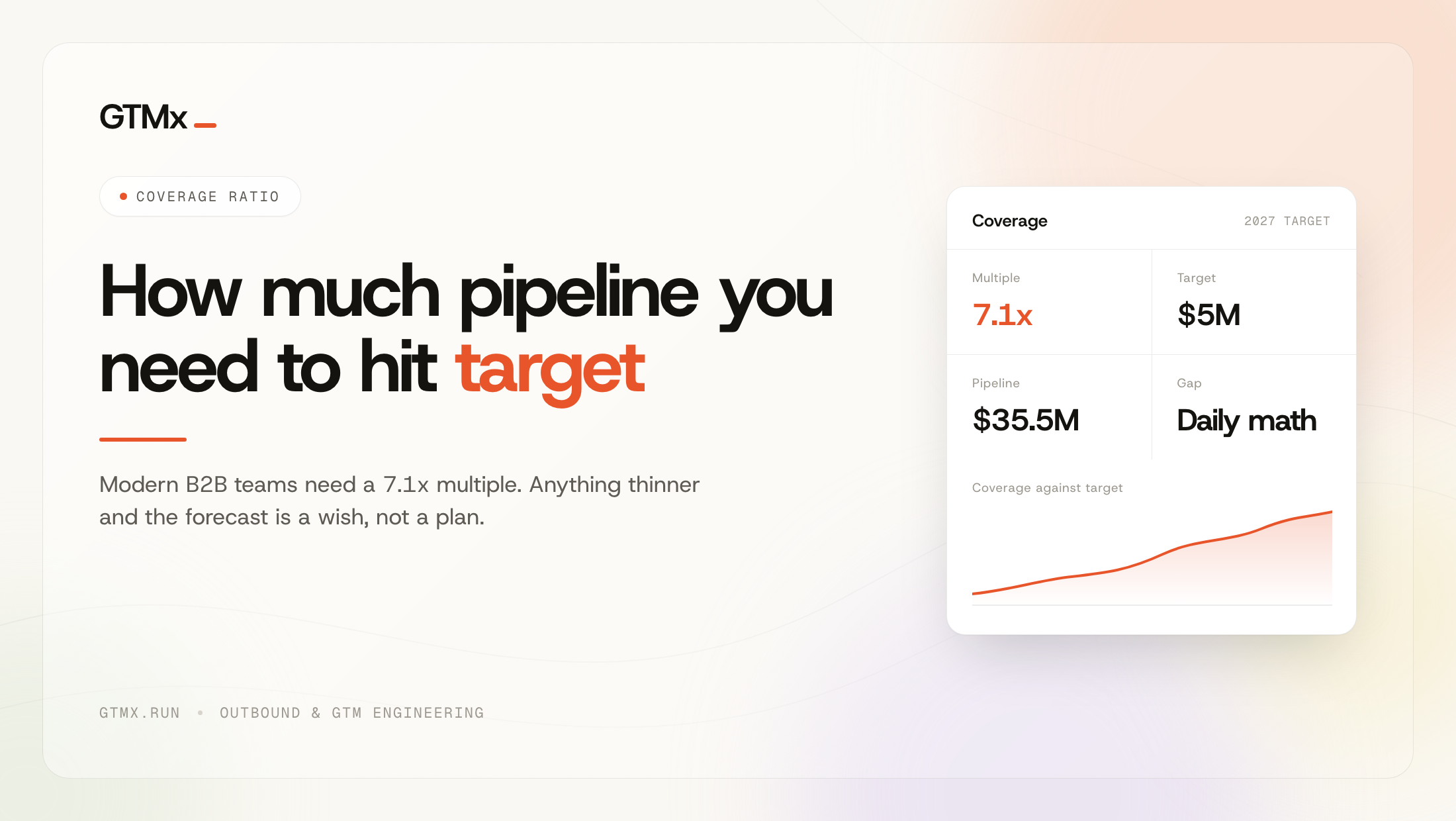
To calculate pipeline coverage ratio, divide 1 by your historical win rate. At Ebsta x Pavilion's 2025 median new-business win rate of 19%, that is about 5.3x, not the old 3x rule. This guide turns the ratio into outbound activity, enrichment and daily sending limits.
TL;DR To calculate pipeline coverage ratio, divide 1 by your historical win rate. At Ebsta x Pavilion's 2025 median new-business win rate of 19%, that is about 5.3x, not the old 3x rule. This guide turns the ratio into outbound activity, enrichment and daily sending limits.
Founders often guess their pipeline needs, causing massive revenue gaps. We will show you how to calculate pipeline coverage ratio using actual win rates and strict outbound rules. You will learn how to turn annual quotas into exact weekly meeting and contact lookup targets.
Key takeaways
- At a 19% median win rate (Ebsta x Pavilion, 2025), required pipeline coverage is about 5.3x quota.
- The basic formula divides total open pipeline by your remaining revenue target.
- Outbound channels require higher coverage ratios than inbound channels to absorb longer sales cycles.
- Inbox deliverability limits impose a hard physical ceiling on your top of funnel volume.
- Stage-weighted forecasting provides a much more realiztic view of potential cash flow.
- Your CRM must track opportunity slippage to prevent phantom pipeline from inflating coverage numbers.
Why the 3x Pipeline Rule is Failing Your Revenue Target
The old pipeline rules ignore recent drops in win rates. Buyers now use AI to check options before ever talking to sales, raising required coverage multiples greatly.
Why has the standard B2B win rate collapsed?
Old sales advice tells you to build three times your quota in pipeline. This advice fails today. Growth stage software win rates dropped to 19 percent recently.
Ebsta and Pavilion published this benchmark in 2025. At a 19% win rate, your unweighted coverage need sits above five times quota.
Relying on an outdated sales playbook leads to missed targets.
How do enterprise deals distort average coverage models?
Blended metrics hide failures at the top end of the market. Large deals usually win less often than small ones, so calculate coverage separately by deal size using your own CRM data.
Use your own win rate for each segment to find the multiple. A lower win rate means a larger pipeline multiple for safe forecasting.
What happens when buying committees expand?
Selling to large companies involves large buying teams, which slows decisions and lowers win rates.
This complexity lowers your early stage conversion rates. You must account for these friction points when planning your targets. Your B2B pipeline required for revenue target goes up accordingly.
How does sales cycle length dictate pipeline timing?
Time kills deals and extends your planning horizon. Longer sales cycles mean you must build pipeline earlier. 6sense's 2025 report puts the typical B2B purchase journey at about 10.1 months.
Pipeline generation for future targets must start up to a year early. A six month sales cycle means your outbound work today pays off two quarters from now.
How Do I Calculate Pipeline Coverage Ratio for the Next Fiscal Year?
You calculate pipeline coverage ratio by dividing your total open pipeline value by your remaining revenue target. This simple ratio reveals whether your current open deals can cover your quota when adjusted for average win rates.
What is the standard pipeline coverage formula B2B teams use?
The basic math involves taking your total open pipeline and dividing it by your revenue goal. This yields your pipeline to quota ratio baseline.
However, this raw number only helps if your CRM data is fully clean. Dirty data gives you a false sense of safety. Clean your pipeline data before relying on this standard formula.
Why does pipeline coverage tracking matter for quota?
Strict pipeline coverage tracking ties directly to sales rep success. Teams that track coverage weekly spot shortfalls while there is still time to act.
Seeing your gap early allows you to fix it. GTMx targets three to five qualified meetings a week to maintain this sales momentum effectively.
How do you set a sales pipeline coverage benchmark?
Different markets need different math. Small, fast deals usually win more often than large ones, so they need a lower coverage multiple than enterprise deals.
A higher win rate requires a lower coverage multiple. Knowing your specific market facts helps you build your first outbound pipeline properly. Base your math on past facts.
The real math behind pipeline coverage ratio
Accurate forecasting demands a custom inverted win rate calculation. This strict mathematical approach removes all guesswork and prevents late quarter panic across your revenue teams. You can build true predictability.
What is the exact pipeline coverage ratio formula?
The formula to calculate pipeline coverage ratio is your total open pipeline divided by your revenue target. Alternatively, calculate your required multiple by dividing one by your historical win rate. For example, a 20 percent win rate needs a 5x multiple.
How do you apply the pipeline to quota ratio to your target?
Once you find your baseline multiple, you map it against your required revenue. If your goal is one million dollars and your multiple is five, you need five million.
You must have five million dollars in open pipeline. This absolute number dictates all your outbound effort. The pipeline to quota ratio gives you a firm goal.
How do you adjust for average contract value facts?
Deal sizes dictate how many single deals you need to generate. If you run B2B SaaS with a high contract value, you need fewer total deals.
Low value deals demand massive volume to reach the same cash target. You must map your outreach volume to your contract value. Small deals require a much wider top of funnel net.
Why should you factor in slipped deals and phantom pipeline?
Not all pipeline is equal, especially when timelines slip. Deals that slip past their planned close date tend to win less often, so discount stalled deals.
Ebsta's 2025 qualification research found well-qualified deals were 1.9 times less likely to slip past their forecast close date. Revenue leaders must heavily discount stalled deals.
Keeping them at full value just inflates your coverage ratio. Scrub these phantom deals from your CRM regularly.
Should I Calculate Pipeline Coverage Ratio Using Weighted Deals?
Teams must separate raw total pipeline from probability adjusted figures to project accurate revenue. Stage-weighted forecasting provides a highly realiztic view of your cash flow based on past conversion data.
What is the case for unweighted pipeline models?
Unweighted models just sum up the total value of all open deals. This view provides a clear picture of absolute top of funnel volume.
It shows your total market traction at a glance. However, it treats an early discovery call and a final contract review exactly the same. You cannot pay bills with early stage pipeline.
How do you use stage-weighted forecasting correctly?
Probability rules solve the absolute value problem. Apply percentage weights to each stage based on your own past stage progression.
A discovery deal might carry a 10 percent weight. A verbal agreement hits 90 percent.
This approach creates a much safer projection model. It is a core part of modern revops engineering as a service.
Where should you set the right entry qualification point?
You must define exactly when a lead becomes actual pipeline. Counting unqualified meetings inflates your numbers and ruins your forecasting accuracy.
Only deals with confirmed budget and clear timelines should enter your formal math. If you let bad leads enter your CRM stages, your coverage multiple becomes useless. Keep your pipeline entry standards very high.
How Do Outbound vs Inbound Pipeline Sources Differ in Their Coverage Needs?
Outbound and inbound channels close deals at totally different rates. Blended coverage ratios hide failure across mixed tiers. You must model your pipeline gap separately for each distinct source to maintain accuracy.
Comparing pipeline needs by source
| Win rate | Required pipeline coverage | Where the win rate comes from | Note |
|---|---|---|---|
| 15% | 6.7x | Example | Hard enterprise deals |
| 19% | 5.3x | Ebsta x Pavilion 2025 median | New-business median |
| 25% | 4.0x | Example | Strong qualification |
| 33% | 3.0x | Example | The old 3x rule assumes this win rate |
Choose outbound models if you need precise account targeting. Choose inbound models if you have high brand authority.
Why does outbound require higher initial multiples?
Cold outreach naturally closes at a lower rate than warm inbound requests. Outbound prospects are not actively seeking a fix right now.
They require much more nurturing and time to close. This demands a higher initial coverage multiple to absorb the lower win rates. Expect to build deeper top of funnel lists to hit your goals safely.
How does expansion revenue alter new logo targets?
Your net retention rate directly changes your new revenue burden. Strong customer upgrades reduce the sheer volume of new logos you must win.
High churn forces your sales team to generate much more pipeline just to break even. If your current clients leave, your outbound team must work twice as hard. Fix churn before scaling outreach.
How do you balance your overall pipeline generation strategy?
Relying purely on one channel brings massive business risk. You need a mix of inbound brand power and highly targeted outbound execution.
A balanced plan ensures you hit your blended multiple even if one channel fails. Build an outbound engine to target specific accounts, and use inbound to catch active buyers. Both sides support each other.
Automated Outbound Engine
See how GTMx builds the engine: secondary sending domains live in 72 hours, waterfall TAM lists tiered by signal in Clay, human-written copy at 70 to 75 words, and same-day warm calls on anyone who engages.
Translating Annual Quota into Outbound Activity and Enrichment
You must reverse engineer your pipeline target into daily activity facts like emails sent and data lookups. This math tells you precisely how much pipeline do i need to succeed.
What is the best way of calculating outbound meeting requirements?
Start with your revenue target and divide by average deal size to find required wins. Multiply those wins by your required coverage ratio.
For example, an agency or services firm that needs ten wins at a 20% win rate needs about 50 opportunities (10 divided by 0.2), and at a 42% meeting-to-opportunity rate roughly 119 qualified meetings (arithmetic). This is the core of calculating outbound meeting requirements correctly.
How do you model waterfall enrichment cost against return?
Data quality dictates your outreach efficiency and tooling costs. Waterfall enrichment checks several providers in sequence, which raises coverage compared with a single source.
This data cascade reduces manual research time greatly. Your pricing must account for the underlying data provider costs. Cheap data ruins your sender reputation quickly.
How do you determine the required volume of outreach touches?
With meeting targets set, calculate the raw outreach volume needed to book them using your own reply and meeting rates. GTMx's working rules are a 2% reply rate, 20% to 25% of replies positive, and about 1 in 3 positive replies booked as meetings.
GTMx writes human copy at 70 to 75 words to maximize replies. Short copy generates more replies and books more meetings.
How Inbox Limits and LinkedIn Caps Break Standard Pipeline Math
Deliverability rules now impose hard physical ceilings on how quickly you can generate top of funnel volume. Teams can no longer spam their way to a target without severe risk.
How do you manage the maximum allowable spam complaint rate?
Major inbox providers heavily restrict bulk senders today. Google and Yahoo enforce a strict maximum allowable spam complaint rate ceiling of 0.30 percent.
They set this rule in their 2024 guidelines. Crossing this mark causes permanent domain blocking.
Your cold email volume models must factor in these strict limits. Send highly targeted messages to stay safe.
Why must you account for tenant external recipient rate limits?
Microsoft limits outbound capacity through tenant external recipient rate limits. These caps restrict how many unique external addresses a single user can email daily.
You must distribute volume across multiple independent domains to scale safely. GTMx caps cold sending at 15 emails a day per Google inbox and 10 per Microsoft inbox, with three inboxes per secondary domain. A campaign sending 1,000 emails a day on Google inboxes needs about 67 inboxes (arithmetic). GTMx can have pre-warmed secondary inboxes live in 72 hours.
How do strict LinkedIn limits change your capacity models?
Social selling faces similar constraints. LinkedIn does not publish an official weekly invitation cap, and practitioners commonly observe about 100 connection requests per week.
You cannot simply buy a premium subscription to bypass these physical barriers. Your volume models must respect these firm platform limits. When you run outbound messaging on LinkedIn, plan for slow, steady growth.
How do you maintain compliance while scaling outreach volume?
Legal frameworks govern how you generate your top of funnel pipeline. The UK ICO guidelines from 2024 demand a formal legitimate interest assessment.
You must distinguish between corporate bodies and individual subscribers accurately. Sole traders need prior consent before you email them.
Ignoring these rules invites severe fines. Clean your lists against legal rules before sending.
How Do We Build an Automated Pipeline Capacity Model in Our CRM?
Modern go to market infrastructure requires a fully automated revops pipeline capacity model living within your CRM. This setup alerts you instantly when coverage drops below your required safe threshold.
Why must you clean historical data before modeling?
Your capacity model is only as good as its raw data. You must scrub zombie deals and fix duplicate records before running any math.
Dirty data creates false positive coverage ratios. A clean foundation ensures your future mathematical projections remain highly accurate.
Never build a pipeline model on unchecked CRM inputs. Take time to audit past wins.
How do you automate CRM alerts for slipping deals?
Time kills momentum in complex sales cycles. You should build automated workflows that flag deals sitting in one stage for too long.
These alerts notify sales leaders to inspect the deal or lower its win probability. This stops phantom pipeline from inflating your numbers. Set these alerts to trigger after fourteen days of silence.
Why should you integrate synthetic intent detection tools?
Modern CRMs can monitor for artificial engagement signals. Synthetic intent detection prevents bots from falsely inflating lead scores and creating fake pipeline.
You want your coverage model built entirely on real human engagement. Removing automated noise keeps your pipeline ratio very clean.
Filter out email scanner bots from your click data. Base steps on verified human actions.
Setting up your CRM tracking environment
- Define your initial CRM entry qualification stage clearly.
- Assign fixed percentage probabilities to each deal stage.
- Automate stale deal closure after thirty inactive days.
- Create distinct pipelines for outbound and inbound sources.
- Build custom reports tracking deal velocity by quarter.
- Configure custom alerts for opportunities that push out.
- Sync enrichment tool data directly to contact records.
- Mandate standard exit criteria for stage progression moves.
- Implement weekly inspection dashboards for all sales leaders.
- Schedule automated monthly reviews of historical win rates.
Free GTM Audit
A free 30-minute GTM audit that maps where your first qualified pipeline would come from, with no pitch. Josh reviews your current motion, your addressable market and the gaps between them to calculate pipeline coverage ratio needs.
Frequently asked questions
What constitutes a compliant B2B cold outreach process under UK GDPR?
Compliant outreach requires understanding the corporate subscriber exemption. You can email limited companies without prior consent if you provide a clear opt out option. However, sole traders and partnerships require strict prior consent. You must always maintain an accurate suppression list.
How many domains and inboxes are required to hit meeting targets safely?
To safely send one thousand cold emails daily, you need at least ten secondary domains with two to three inboxes each. This structure keeps individual sender volumes low enough to avoid penalties. Never send outbound volume from your primary domain.
How should you treat pipeline that pushes across quarters?
Track your own push rate: the share of pipeline whose close date moves into a later quarter. Ebsta's 2025 qualification research found well-qualified deals were 1.9 times less likely to slip past their forecast close date, so a high push rate is also a qualification signal. Discount pushed deals in your forecasting models. If you treat pushed deals at full value, your quarterly coverage ratio will be artificially inflated.
Why do blended coverage ratios conceal failure across mixed tiers?
Blended ratios average out high volume small deals with low volume enterprise opportunities. This creates a dangerous middle ground metric that applies to neither segment accurately. You must segment your reporting to see where coverage gaps actually exist in your business.
How does average contract value alter our coverage ratio requirements?
Higher contract values usually correspond with lower conversion rates and longer sales cycles. This means enterprise deals require higher multiples, often six times or more, to safely hit targets. Smaller deals close faster at higher rates, allowing tighter multiples like two and a half times your target.
How many SDR outreach touches does it take to generate pipeline?
It depends on your own reply and meeting rates. GTMx's working rules are a reply rate of at least 2%, 20% to 25% of replies positive, and roughly 1 in 3 to 1 in 2 positive replies booked as meetings. That works out to about 400 to 750 contacts per booked meeting (arithmetic), spread safely across multiple domains. Replace these rates with your own data as soon as you have it.