What Should a CEO Personally Own in the Sales Process in 2027 and What Should Be Systemized?
By Bhushan Raj ShakyaSEO Specialist
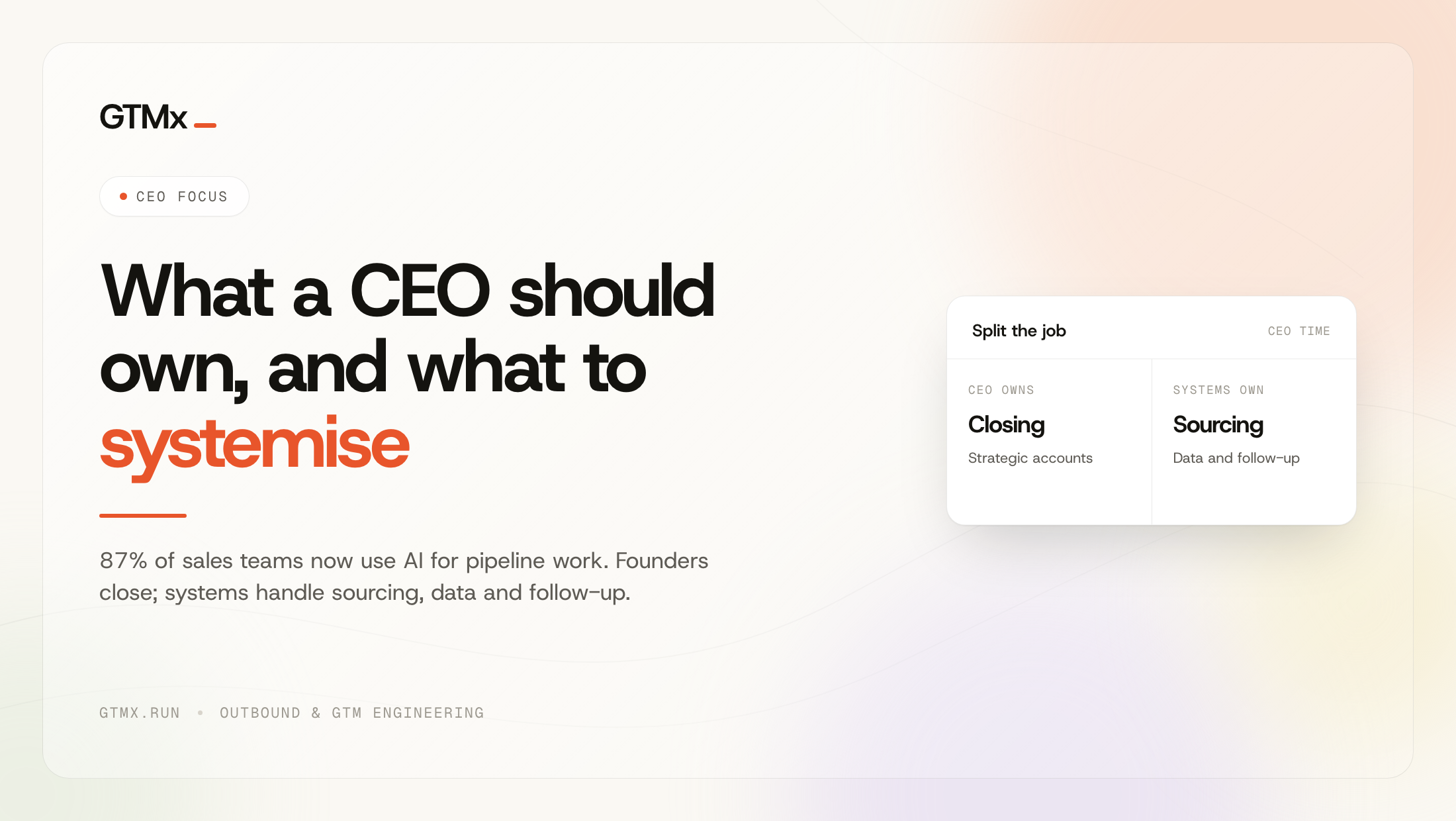
The CEO's role in the sales process shifts from prospecting to closing and strategy as a company grows. Founders should stop manual outreach, let systems handle data enrichment and sending, and stay in the conversations that need them, such as enterprise demos.
TL;DR The CEO's role in the sales process shifts from prospecting to closing and strategy as a company grows. Founders should stop manual outreach, let systems handle data enrichment and sending, and stay in the conversations that need them, such as enterprise demos.
Most advice tells founders to hold onto sales calls until they hit a million in revenue. In truth, holding the reins too long kills your pipeline, forcing the CEO role in sales process to change. We will show you which parts of the outbound engine to systemize and where to step in.
Key takeaways
- AI agents and waterfall enrichment now handle all top-of-funnel research.
- Google and Yahoo spam limits make manual batch emails too risky.
- Enterprise buyers demand executive presence only at the final closing stage.
- Reaching the inbox requires secondary domains and constant safety monitoring.
- Founders hurt their own pipeline when they refuse to systemize outreach.
- A modern GTM engine separates automated prospecting from high-stakes trust conversations.
Why is the CEO's role in sales shifting?
Manual prospecting is technically broken, forcing the CEO role in sales process strictly towards closing. Founders who manually search for leads waste precious hours that should go towards building trust with buying committees.
Why does founder-led prospecting hit a hard ceiling?
Founders can sell directly early on to win initial deals. However, founder-led sales hits a ceiling fast as the company grows, because the CEO's calendar becomes the bottleneck.
Much of a seller's week goes to admin work rather than selling. You must separate high-value strategic conversations from manual tasks. Why your sales playbook won't scale depends on how fast you adapt.
How do inbox spam mandates affect bulk sending?
Spam limits from Google and Yahoo now enforce strict inbox deliverability mandates on bulk senders. You must keep spam complaint rates strictly below 0.30% at all times. This strict rule helps you avoid permanent domain blocks.
A CEO manually sending emails without rotating secondary domains risks severe harm. You could easily take down the entire corporate workspace in days. Systems fix this basic flaw.
What is the impact of agentic AI on research?
Modern teams use agentic AI for research to map accounts fast. Systems like Clay use smart logic to sequence many data sources automatically. This logic stops at the first true match to save money.
This setup raises verified contact coverage compared with a single provider and with manual research. The system applies your buying criteria while the founder sleeps.
Why does holding the top of the funnel limit growth?
Doing every single sales task limits your company growth over time. Nearly half of first senior sales hires fail within two years because the company lacks a true system.
Systematizing sales for founders forces you to document the strict rules. It removes the CEO as the core block for booking initial meetings. It lets you scale with total ease.
When should a founder or CEO step out of day-to-day sales?
When should CEO stop prospecting? A founder must step away from pipeline generation once the company finds a repeatable sales motion. You must systemize the outreach to scale effectively beyond your personal executive networks.
How do you spot the signs of pipeline burnout?
Founders often realize too late that their limited time caps revenue growth. When your week goes into drafting basic emails, your overall closing rate drops.
You start missing key goals on core company operations. Delaying this shift harms your outbound engine. You must step back to let the smart system generate fresh leads.
How do you move from personal networks to cold markets?
Selling to old friends takes a different motion than pitching cold accounts. Cold B2B outreach demands high volume and strict follow-up rules.
LinkedIn limits connection requests to about 100 to 200 per week. This rule requires a smart, measured presence online. A systemized approach ensures deep market coverage without human delay.
Why should you automate qualification to save time?
Delegating B2B sales operations keeps bad meetings off your busy calendar. Using intent signals removes poor-fit companies before you even speak to them.
GTMx books three to five qualified meetings a week by letting real data lead. You only speak to buyers who fit the strict profile. You can book a free GTM audit to spot the big gaps.
What parts of the sales workflow can systems fully run?
Modern teams can fully systemize account research, contact enrichment, multichannel outreach, and initial meeting scheduling. This setup leaves only the complex negotiation and closing stages entirely reserved for human executives.
What is waterfall enrichment and how does it replace manual SDR research?
Waterfall enrichment sequentially queries over 150 data providers to find verified contact information. It stops at the first correct match to save money.
This process creates highly accurate contact lists and replaces manual SDR data entry entirely. It runs smoothly in the background.
How do you manage complex data enrichment automatically?
Enrichment goes far beyond finding a basic email address for your lead lists. Tools can verify if a company uses specific software or recently hired new staff.
This fresh data scores the lead on actual fit. Your outreach relies on these hard facts instead of guessing. You build a strong pipeline on real signals.
How can you execute multichannel touches without human delay?
A great engine runs automated prospecting workflows on the exact same prospects. A smart system can trigger a profile visit the moment a prospect opens an email.
GTMx runs warm calling on the same day someone engages. This quick coordination happens instantly without manual task lists. Most meetings are booked right on these calls.
Who handles initial replies and CRM updates?
Initial prospect replies often ask for simple information or new times to meet. AI systems triage these early responses directly within your active inbox. The smart system sorts positive intent quickly.
It logs the interaction straight into HubSpot. This automated workflow removes the busywork from the executive team entirely and keeps your CRM updated. Check our case studies for proof.
Which technical rules force CEOs away from manual sending?
Strict global email rules now enforce the separation of executive operations from marketing activities. You must isolate your prospecting infrastructure immediately to protect the main corporate identity and ensure good deliverability.
How do you protect the primary corporate domain?
Never send automated outbound emails from your main corporate domain. GTMx sets up secondary domains that redirect straight back to your primary website.
These domains receive proper SPF, DKIM, and DMARC records before sending a single message. This separate setup keeps your internal emails entirely safe from strict spam filters.
What are the UK PECR and GDPR requirements?
Direct B2B marketing faces strict legal oversight globally. Under UK PECR, firms can contact corporate subscribers without prior consent if they provide clear opt-outs. You must still prove a legitimate interest.
Automated systems handle these opt-outs instantly to keep you compliant. You must deal with these rules properly. This is general guidance, not legal advice.
How can teams safely handle LinkedIn automation limits?
LinkedIn actively restricts automated scraping and high-volume bot activity. You must operate within strict daily limits to protect your valuable personal profile.
A managed system rewrites your profile for replies and safely manages the connection volume. using AI to build a safe system syncs those chats directly to your CRM without triggering platform security flags.
How does the CEO's role in sales affect buyer trust?
Enterprise buyers value the authority of a founder during strategic talks, but they do not expect founders to handle cold outreach. When the CEO role in sales process shifts purely to closing, buyers feel they receive true executive priority.
When should you use automated systems versus executive presence?
| Stage | Automated System | Executive CEO |
|---|---|---|
| Account Research | Yes | No |
| First Touch Outreach | Yes | No |
| Technical Qualification | Yes | No |
| Security Reviews | No | Yes |
| Final Pricing Negotiation | No | Yes |
Automate the early pipeline stages where volume and speed matter most. Bring the executive in only when the buyer requires high-level business validation.
What is the true value of executive sponsorship?
Complex deals often involve six to ten stakeholders in a B2B buying committee. These groups require serious proof that the vendor will support their long-term operational goals.
A CEO stepping in at this late stage provides immense trust. It signals that the vendor takes the strategic partnership very seriously.
How do you meet the modern rep-free preference?
Buyers increasingly want to test technical products on their own terms. Gartner's surveys found 61% of B2B buyers preferred a rep-free buying experience in 2025 and 67% in 2026.
Automated systems give the right data without forcing a premature human chat. This approach matches modern buying habits perfectly for early pipeline stages.
Who handles security and compliance reviews?
In strict sectors like finance, buyers have zero tolerance for careless outreach. The buying group checks founder integrity during the vendor security review.
The CEO must personally validate the technical posture and address specific risk concerns. Automated systems simply cannot manage these highly bespoke enterprise compliance talks. You must lead these calls.
Build Your Automated Outbound Engine
Stop burning executive hours on manual tasks. GTMx builds your Automated Outbound engine with secondary sending domains live in 72 hours, waterfall TAM lists tiered by signal in Clay, human-written copy at 70 to 75 words, and same-day warm calls.
View The Automated Outbound Service →
What is the CEO's specific responsibility during enterprise sales demos?
During an enterprise demo, CEO closing vs prospecting becomes very clear. The CEO must focus on aligning the product roadmap with the client's strategic goals rather than showing basic features. The executive builds the deep trust needed to close complex deals.
Why should you focus on strategic alignment over features?
A CEO should never run a basic software feature demo. Your true role involves grasping the broader market challenges the prospect currently faces. You must connect your solution to their high-level financial goals.
Leave the basic button-clicking to a dedicated sales engineer. Focus entirely on executive trust building to close the deal.
How do you manage buying committee dynamics?
Buying committees consist of competing internal interests and highly varied goals. The CEO must act as a trusted peer to the prospect's senior leadership team.
You must identify the underlying fears of the CFO or chief risk officer. Building a strong consensus among these diverse leaders remains your main multi-threaded trust building job.
How do you address bespoke enterprise terms?
Enterprise deals often require custom legal agreements or highly unique service levels. A systemized process handles standard pricing models, but executives manage structural changes.
You hold the unique authority to approve non-standard terms that secure the massive contract. This flexibility is a major plus of retaining founder input here.
How do we transition from founder-led sales to a systemized sales engine?
Moving to a systemized engine requires checking your current successful deals to map the exact criteria that indicate a good fit. You then build automated workflows to replicate that precise targeting at massive scale.
How do you map the total addressable market?
You must first define exactly who you want to reach. A successful shift requires strict ICP and TAM mapping based on past client data.
GTMx helps companies identify markets with at least 20,000 valid accounts to justify the build. We target prospects based on real fit signals instead of broad groups.
How do you build a waterfall enrichment pipeline?
Building an automated list-enrichment pipeline involves wiring your CRM to external data providers. A proper waterfall enrichment pipeline routes form fills and enriched data directly into HubSpot.
You set lead scoring rules based on specific technology usage or active hiring trends. This technical step creates a CRM that runs itself.
How do you document the messaging framework?
Automated copy must sound completely human to work well. We restrict cold email length to 70 to 75 words at most. AI helps draft the early options.
Experienced humans edit the final text. You must test these outbound messages every single week to learn from real prospect replies and boost performance.
How do you train the RevOps infrastructure?
A truly scalable system needs solid technical foundations and very clear reporting. Workflows, sequences, and lead data must live entirely in your own accounts.
A shared live dashboard tracks daily reply data and newly booked meetings. This total clarity ensures the business owns the outbound system completely without agency lock-in.
Why do traditional outbound sales templates fail to convert today?
What should CEO own in sales? Traditional sales templates fail because buyers instantly spot automated patterns and send them straight to spam. Modern systems use real-time signal data to trigger highly specific, contextual messages that demand attention.
Why is the generic sales template dead?
Buyers receive dozens of automated cold pitches every single day. If your email looks like a standard template, they will ignore it fast.
6sense's 2025 Buyer Experience Report puts the typical B2B purchase journey at about 10.1 months. You cannot shorten this long cycle with generic outreach that lacks distinct market value and true insight.
How do you use situational and signal-based targeting?
Modern outreach relies on specific triggers rather than static contact lists. You contact a B2B SaaS company because they just raised funding or changed a core software tool.
This situational context proves you did your detailed homework beforehand. It shifts the entire chat from a cold pitch to a highly timely help offer.
How do you coordinate the multichannel approach?
Single-channel campaigns rarely generate enough pipeline for modern tech companies. Systemizing CEO sales role means email opens the door, but LinkedIn builds familiarity over time.
The final step involves warm calling the exact people who showed interest. Most meetings actually get booked on the call after a second distinct channel interaction.
10 steps to systemize your outbound engine
- Audit your total addressable market size.
- Purchase and register secondary sending domains.
- Configure SPF, DKIM, and DMARC records.
- Connect multiple data providers via Clay.
- Define strict lead scoring parameters.
- Write email copy under 75 words.
- Set daily connection limits on LinkedIn.
- Route all positive replies to a central dashboard.
- Implement same-day calling for engaged prospects.
- Remove executive accounts from early-stage sequences.
Claim Your Free GTM Audit
Ready to systemize your outbound motion? Get a free 30-minute GTM audit that maps exactly where your first qualified pipeline would come from, with no pitch. Josh reviews your current motion, addressable market, and technical gaps.
Frequently asked questions
How do we keep our outbound cold email below Google's 0.3% spam limit?
You must use SPF, DKIM, and DMARC on secondary sending domains before launching campaigns. Restrict your sending volume per inbox, rotate multiple domains, and include one-click unsubscribe links. GTMx sets up pre-warmed inboxes live in 72 hours to protect your deliverability score automatically.
What is the true ROI of replacing SDR list-building with agentic AI workflows?
Manual SDR research is slow and prone to basic errors. AI tools and waterfall enrichment can evaluate thousands of accounts at once and raise verified data coverage. GTMx's blog puts first-pipeline tooling under $1,000 a month.
Should our CEO's personal LinkedIn profile be used in automated outreach?
Yes, but with strict safety rules in place. LinkedIn caps connection requests to roughly 100 to 200 per week. You must use a managed system that respects these limits, rewrites your profile for replies, and syncs engagement data directly to HubSpot or Salesforce to avoid account bans.
Does involving the CEO in sales negotiations hurt enterprise pricing power?
No, it actually strengthens it when done correctly. A CEO stepping into the final stages signals immense respect for the buying committee. You hold the unique authority to approve bespoke terms and secure long-term contracts, which often justifies premium pricing for enterprise-level vendor partnerships.
How do we transition from founder-led sales to a systemized sales engine?
Start with a clear TAM map and define the strict signals that indicate a good fit. Implement tools like Clay for enrichment and Smartlead for safe sending. GTMx builds the full engine in your own accounts, delivering a completely systemized CRM that runs itself smoothly.
Which parts of the B2B sales pipeline can be completely automated with AI?
You can automate account research, waterfall data enrichment, multichannel sequence orchestration, and initial reply triage. AI systems evaluate fit signals, send contextual emails, and route positive responses to your CRM. This reserves human effort entirely for same-day warm calling and executive closing conversations. ---