How Should a Small B2B Team Expand Into a New Market in 2027?
By Bhushan Raj ShakyaSEO Specialist
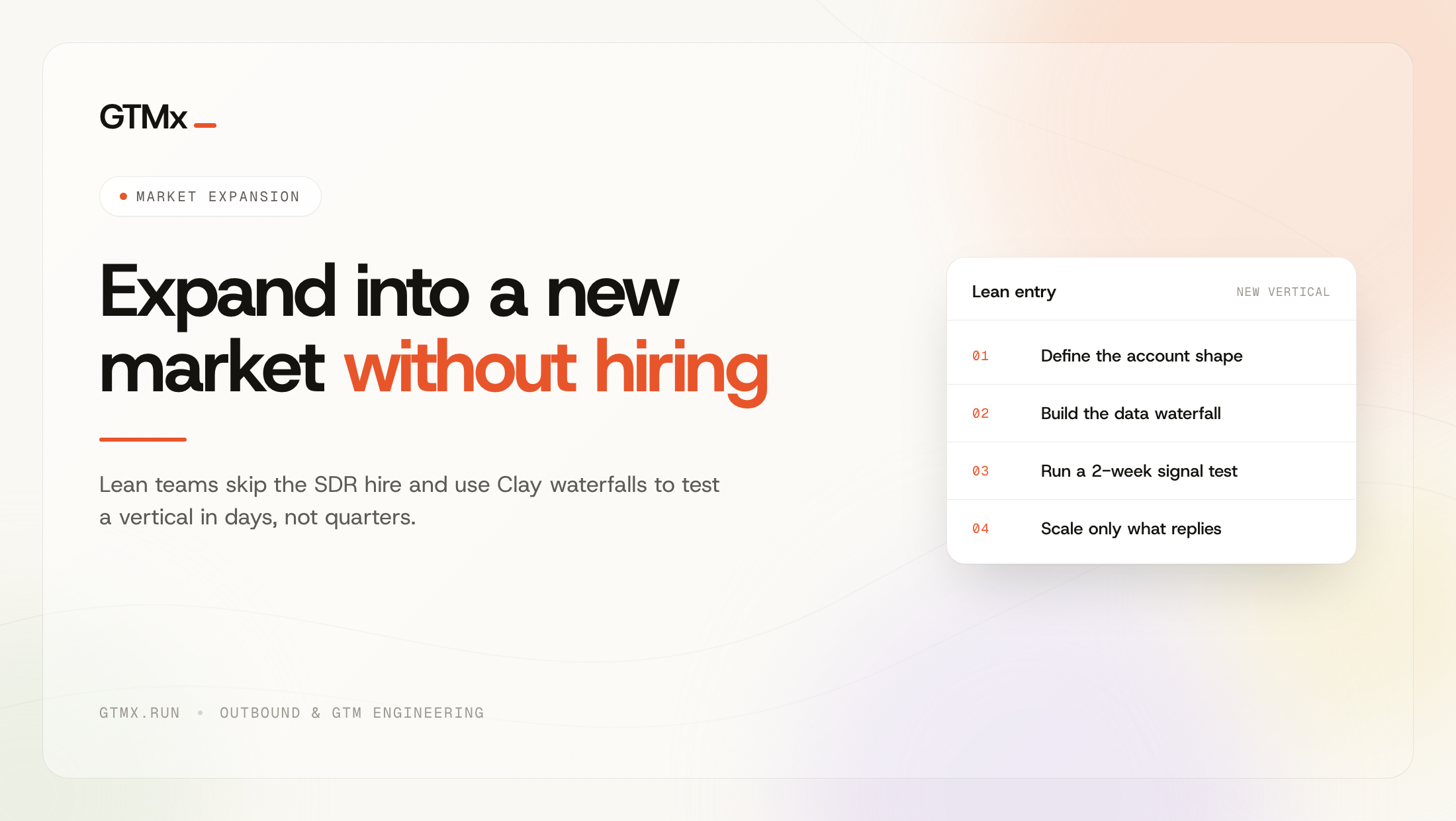
To expand into a new B2B market, lean teams bypass expensive SDR hires and use Clay waterfalls to test verticals in days. B2B new market expansion now requires strict technical infrastructure to survive a 0.30 percent spam complaint limit.
TL;DR To expand into a new B2B market, lean teams bypass expensive SDR hires and use Clay waterfalls to test verticals in days. B2B new market expansion now requires strict technical infrastructure to survive a 0.30 percent spam complaint limit.
Small teams often waste time and cash when they try to expand into a new B2B market. You need real market feedback to test your ideas quickly without wasting budget. This guide shows you how to use modern GTM engineering to map and breach a new vertical.
Key takeaways
- Old expansion methods take months, whereas GTM engineering tests new markets in days.
- B2B contact data decays fast, making waterfall enrichment vital for valid targeting.
- Mail providers strictly cap spam complaint rates at 0.30 percent before blocking domains.
- Secondary sending infrastructure keeps your primary business domain safe from deliverability risks completely.
- AI works best for market research rather than writing outbound messaging directly.
- Same-day warm calls on engaged prospects greatly improve meeting booking rates in new niches.
Why do old methods fail when you expand into a new B2B market?
Old plans to enter a new B2B market burn cash and time. Lean teams avoid early hiring and expensive lists by using automated tools to test verticals fast.
Why is early sales hiring a mistake?
Startups often hire sales leaders when they enter a new space. This fails often and wastes money.
Hiring a senior sales leader first means paying for a scaling hire before you have proven that outbound works. An automated outbound engine gives better feedback than a costly new hire.
Why are static databases dangerous for outbound market entry?
When testing new B2B verticals, buying static lists for your outbound market entry brings poor results. Contact records break down fast as people change jobs.
B2B contact data decays steadily, so build lists dynamically and re-verify them before every campaign.
Why is six months of research too slow?
Old methods demand months of theory before you send one message. This wastes testing time. You learn from real replies, not six weeks of planning.
GTM engineering lets you launch targeted tests quickly. You gather actual market feedback that proves your product works for buyers today.
Setting a lean market penetration strategy
A lean market penetration strategy requires testing core ideas through small, rapid checks. You map a targeted list, write focused copy and measure the response.
If the market rejects your offer, you pivot quickly. This stops you from wasting heavy resources on a bad niche blindly.
What are the risks when you expand into a new B2B market?
Technical rules control your ability to reach prospects in a new territory. You must set up your mailboxes right and check local privacy laws before you launch.
What are the new rules of inbox placement?
Email hosts now enforce strict technical rules for bulk senders. Senders must publish correct records and keep their spam complaint rate below 0.30 percent (Google, 2026).
When testing a new market, bad copy often causes complaints. You must watch these limits daily to survive blocklists.
Navigating UK GDPR and PECR rules
Privacy rules change based on your target region. Under UK PECR, cold emailing corporate contacts is legal if you offer clear opt-outs (ICO, 2026).
Always check local laws before testing a European market. Some states enforce strict rules that forbid cold outbound entirely.
Why does domain trust dictate your success?
Poor technical setups mean your messages never reach buyers. Missing SPF, DKIM or DMARC records, or sending from a cold domain, sends mail to spam.
You must warm up your setup before sending a pitch. Trust with mail servers is vital for success.
How do you build a TAM model for market expansion?
Building a total addressable market list means scraping live signals rather than buying generic data. You pull real company details to find businesses that match your exact needs.
What is TAM modeling for market expansion?
TAM modeling for market expansion is the process of sizing a new market using live data signals rather than static lists. RevOps engineers build a total addressable market by checking tech data, hiring trends and specific website keywords to find your exact target accounts automatically.
Sourcing raw accounts via scraping
You cannot rely on basic job titles to find complex buyers. Instead, pull data from niche sites or use AI agents to scan company pages, then match those data points to relevant prospects. For example, GTMx's OpenSponsorship campaign scraped brand websites to extract specific products and matched them to relevant athletes.
Scoring fit with technographic signals
Technical clues reveal buyer intent better than firmographic data alone. You score fit with technographic signals to find companies using specific software.
This identifies accounts primed for a change. When selling to B2B SaaS companies, the buying team often spans multiple departments who rely on these stack links.
How do you handle disqualifying weak accounts early?
Disqualifying weak accounts early saves time and protects your sender score from bounces. You can set AI web agents to check company sites for negative clues automatically.
This removes bad businesses from your list at once. This keeps your list clean and saves your enrichment credits.
How does waterfall enrichment in clay maximize your email coverage?
Waterfall enrichment links multiple data providers to find contact details efficiently. This method finds more valid emails while keeping the cost of third-party credits low.
How does waterfall enrichment actually work in Clay?
Clay allows you to check multiple data sources in order. The system checks your first provider for an email and only moves to the second if the first fails.
Order your providers so cheaper sources run first, which keeps your data spend under control. This keeps your sales playbook scalable.
Stacking data providers for efficiency
You must order your providers carefully to control your costs. Start with lower-cost sources and call premium vendors only to fill the gaps.
Why does multi-provider waterfall routing beat single sources?
Relying on a single premium vendor leaves gaps in your contact list. Multi-provider waterfall routing checks several sources in sequence, which raises coverage. This plan is vital when entering markets with high staff turnover.
How should you configure your outbound setup?
Launching into a new sector requires dedicated sending tools to protect your main brand. You must set up secondary domains and mailboxes before starting. This keeps your market test safe.
Comparing setup choices
| Criteria | Lean Test Setup | Enterprise Scale |
|---|---|---|
| Domain Strategy | Secondary domains | Subdomains |
| Inbox Setup | Distribute volume | Heavy API routing |
| Cost Profile | Low upfront spend | High monthly fee |
| Risk Level | Fully isolated | Core domain risk |
Secondary domains keep your primary brand safe from strict penalties. Spreading volume across multiple inboxes is the best way to scale safely.
Setting up secondary sending domains
GTMx never sends outbound messages from a client primary domain. You must buy secondary sending domains that redirect to your main site and set up proper records.
This step isolates the risk of your market test. It ensures your core business emails remain safe from early complaints.
Connecting mailboxes smoothly
Moving data files by hand causes errors and delays your follow up steps. You should route new records directly into your CRM automatically.
The system can score incoming leads and trigger outreach steps without manual effort. This smooth data flow helps your lean team manage prospects easily.
How do you manage your LinkedIn outreach safely?
LinkedIn is a strong channel for building trust after an initial email. However, you must respect platform limits strictly to avoid bans.
LinkedIn does not publish an official weekly invitation cap, and practitioners commonly observe about 100 connection requests per week. Balancing automated tools to manage your LinkedIn outreach with cold email works best.
Automate Your Outbound Engine
See how GTMx builds your automated outbound engine. We configure secondary sending domains live in 72 hours, create waterfall TAM lists tiered by signal in Clay, write copy restricted to 75 words, and make same-day warm calls on engaged leads.
What messaging strategies earn replies from cold buyers?
Your messages must focus on buyer pain rather than generic product features. Short, specific emails perform best when you target new buyers in an adjacent market.
How should you use AI for research instead of writing?
AI written copy often sounds fake and triggers spam filters. The real value of AI in outbound is research, not writing.
Use it to map industry pain points before you draft the message yourself. Human written copy works better with wary buyers because they want real expert insight.
The 75-word rule for human copy
Long emails rarely get read on mobile devices by busy executives. You must keep your initial outreach extremely short.
GTMx restricts human written copy to 70 to 75 words at most to ensure maximum clarity. This forces you to focus entirely on the buyer problem rather than listing features.
Writing messages that earn replies via behavioral signals
Most meetings do not come from the first message you send. About 42 percent of cold campaign responses derive from follow up messages rather than initial touches (Instantly, 2026).
Trigger subsequent emails or calls when prospects open or click your first touch. Writing messages that earn replies requires clear follow ups.
How do you launch new market tests fast?
A rapid market test requires launching your campaigns quickly and tracking the data daily. You use early engagement metrics to fix your targeting and messaging in real time.
How many target accounts are sufficient for a test?
You need enough volume to get clear proof without burning your entire market. Testing 500 to 1,000 highly qualified accounts provides enough data to measure interest.
This reveals whether your messaging hits a real nerve. If your reply rate is poor, you adjust your angle fast.
Launching campaigns in 72 hours
Endless planning cycles kill momentum for new market tests. GTMx sets up pre-warmed inboxes, domains and initial targeting lists live in 72 hours.
You gather actual market feedback instead of debating theories. When targeting commercial cleaning firms, you bypass facility managers and speak directly to business owners.
Why should you execute same-day warm calls?
Following up quickly on engaged accounts increases your conversion rate vastly. We recommend placing same-day warm calls to anyone who opens or clicks your email.
You qualify the prospect on the call and book them straight onto your calendar. This step converts mild interest into a meeting fast.
Measuring pipeline generated
Your primary metric for success is the number of qualified meetings booked. You track pipeline value generated from the specific test segment.
Measuring vanity metrics like open rates distracts you from actual revenue potential. When shows positive returns, you know you have found product market fit.
How do you transition to an ongoing sales motion?
Once your initial test proves successful, you must link the workflow into your regular operations. This step turns a manual test into an automated revenue system that runs continuously. You transition to an ongoing sales motion smoothly.
Transitioning from test to core system
An isolated test must eventually become part of your daily sales habits. You need to move successful messaging sequences and targeting rules into your primary CRM. This ensures your sales team can handle the new vertical smoothly. Book a free 30-minute GTM audit to map this transition effectively.
Syncing data to your CRM
Proper data hygiene is crucial when scaling up your campaigns. You must map custom properties in your CRM to split new vertical tests from your core data.
This allows accurate reporting on your ongoing market expansion. A well structured CRM tracks the exact origin of every deal clearly.
How do you maintain long-term inbox placement?
Scaling your volume requires constant focus on your domain trust. You must rotate mailboxes and monitor your spam complaint rates daily.
GTMx's Engine package starts from $6,500 a month, and the $2,450 Pilot is credited toward it if you continue.
Ten steps for entering a new B2B market
- Define your initial hypothesis for the new vertical.
- Register three secondary domains for testing.
- Configure SPF, DKIM and DMARC records correctly.
- Build a targeted TAM list using live signals.
- Run your list through a multi-provider data waterfall.
- Filter out unqualified accounts automatically.
- Draft short copy restricted to 75 words.
- Launch campaigns to a small subset of accounts.
- Execute same-day warm calls on engaged prospects.
- Review reply data and iterate your messaging weekly.
Map Your First Pipeline
Book a free 30-minute GTM audit that maps where your first qualified pipeline would come from, with no pitch. Josh reviews your current motion, your addressable market and the gaps between them to plan your expansion.
Frequently asked questions
How do we test a new B2B niche without hiring an SDR agency?
You bypass agency retainers by using GTM engineering. Set up secondary domains, build a waterfall TAM list in Clay and restrict your copy to short emails. This automated setup gathers real market feedback in days instead of locking you into a long SDR contract before you know the vertical converts.
Is cold emailing corporate contacts legal under UK GDPR and PECR?
Yes, B2B marketing emails to corporate bodies do not require prior consent under UK PECR. However, you must satisfy the UK GDPR legitimate interest test and provide a clear opt-out. Sole traders require prior consent. This is general guidance and not legal advice, so consult a professional before sending.
Why are our emails bouncing or heading to junk when testing a new niche?
Launching campaigns without warming your secondary domains triggers spam filters. Providers like Google cap spam complaints at 0.30 percent. If your new vertical targeting is poor, complaints spike and your trust crashes. You must configure SPF, DKIM and DMARC correctly to ensure your messages reach the primary inbox consistently.
How does a multi-provider data waterfall actually work?
A multi-provider data waterfall queries data providers in order to find accurate contact details. The system checks your first source and only moves to the second if the first fails. You only pay credits when a provider successfully resolves the data, which cuts costs while maximizing your valid email coverage.
What CRM fields must be mapped to ensure clear reporting on new vertical traction?
You must create custom properties to track the exact origin of every prospect. Map fields for lead source, specific campaign name, vertical segment and lead score. This separation prevents your experimental data from polluting your core metrics and allows you to measure the exact pipeline generated by the test.
How do we balance cold email with automated social touches safely?
You balance channels by strictly managing your daily platform activity. LinkedIn does not publish an official weekly invitation cap, and practitioners commonly observe about 100 connection requests per week. Use email for your initial outreach, then use social touches to build familiarity and follow up. This staggered approach avoids restrictions while keeping your brand visible. ---