What Is the Fastest Way to Test Demand for a New B2B Offer in 2027?
By Bhushan Raj ShakyaSEO Specialist
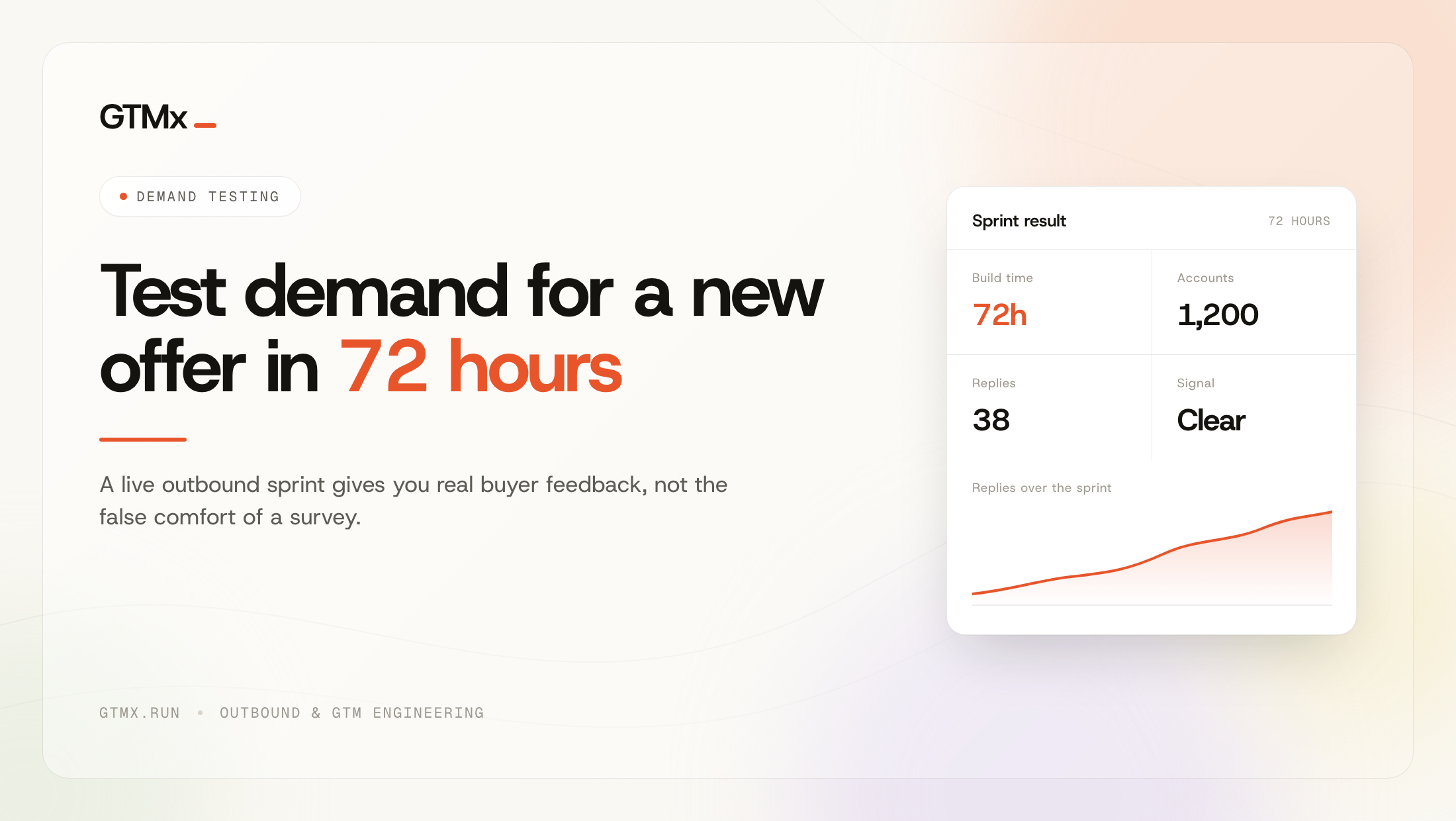
To test demand for a new B2B offer quickly, launch a 72 hour outbound sprint using Clay and GTMx. You get real feedback from live buyers, avoiding the false hopes of surveys.
TL;DR To test demand for a new B2B offer quickly, launch a 72 hour outbound sprint using Clay and GTMx. You get real feedback from live buyers, avoiding the false hopes of surveys.
Most founders spend months asking friendly contacts if they like a new idea. This gives false hope, as buyers rarely tell the truth without a real bill to pay. To find the truth, you must test demand for a new B2B offer with live outbound data.
Key takeaways
- Traditional surveys produce false positives because buyers rarely predict their own future actions accurately.
- Deploying a 72 hour outbound validation sprint tests positioning against real objections from true decision makers.
- Secondary domains must carry strict SPF, DKIM and DMARC alignment to survive Google and Yahoo bulk sender rules.
- Waterfall enrichment in tools like Clay checks several providers in sequence to raise verified email coverage.
- Human written copy of 70 to 75 words generates significantly higher response rates than longer pitches.
- Validating demand requires categorizing real reply sentiment rather than tracking vanity open rates or clicks.
Why Does Traditional Market Research Fail B2B Founders?
Asking people what they might buy gives bad data. Buyers only show real intent when faced with a true commercial choice. You must test offers with real cold outreach to see who actually replies.
Why do discovery interviews produce false hope?
Founders often ask friendly contacts to judge a new service. These contacts want to help and rarely give blunt truths. They agree an idea sounds good without spending real money.
You build a product no one buys. Stop guessing and start checking with live data. Theoretical market demand validation B2B fails because it lacks friction.
What is the high cost of delayed offer testing?
Waiting for survey results burns cash. Nearly half of first senior sales hires at B2B tech companies lose their jobs within two years. They fail because they sell an unproven product.
Rapid testing stops this trap entirely. You prove the demand is real before you hire anyone new for your team.
How do you validate without a built product?
You do not need a finished tool to check market interest. You only need a clear pitch and a safe way to send it. A targeted 72 hour outbound test acts as a real smoke test.
You see if the market cares before spending money. Rapid offer testing outbound gives you truth fast.
Why does a system beat a single campaign?
Testing needs a system, not a one-off blast. You need a setup that lets you swap messages based on feedback and compare them on enough contacts. GTMx's rule of thumb is about 1,000 contacts per variant.
This lets you learn from real replies and fix your pitch quickly to win.
How Do You Map Your ICP to Test Demand for a New B2B Offer?
You must define who feels the exact pain you solve before you test demand for a new B2B offer. A sharp market map ensures you reach enough real buyers to get valid test data.
How do you define the ideal customer profile stack?
Your ideal buyer is a stack of traits, not a job title. For software firms, look at tech stacks and staff growth. Tighter segments tend to reply better: Hunter's 2026 data found sequences to 21 to 50 recipients averaged a 6.2% reply rate against 2.4% for 500 or more.
Small lists suit early signal checks, but you still need enough accounts to test several angles.
How do you calculate your addressable market size?
You need enough prospects to run a valid test. We look for a total market above 20,000 accounts. This size lets you swap messages and test new angles safely.
A market that is too small burns out before you find the winning pitch. This leaves you stuck with no data.
How should you group lists by clear firmographic signals?
Do not buy old, static lists to test new products. You must group prospects by clear signals, like job changes or new rules. Breaking your market into tight groups reveals who cares the most.
This clear focus brings much better response rates for market demand validation B2B tests. Targeting signals proves your concept works.
Build Multi Vendor Waterfall Enrichment Flows
Finding good contact data takes more than one source. You must cascade your lists through many data tools in order. This smart method boosts your match rate and protects your sender score.
What tools build a B2B waterfall enrichment pipeline?
A good waterfall data flow connects many tools in order. Teams use Clay as the main engine and add providers behind it. GTMx's email waterfall starts with one provider, then a higher-volume provider, and can use BetterContact as the final step.
How does Clay speed up account research?
Clay uses AI to do account research at scale. The AI reads company sites and pulls specific facts for your emails. This makes every note feel truly personal and highly relevant.
A custom scraper can pull the data points that job titles miss. GTMx's OpenSponsorship campaign scraped brand websites to extract specific products and matched them to athletes in the marketplace. It scales your research instantly.
How can you handle catch all domains for better reach?
Many business domains accept all mail, masking bad addresses. You must use special tools to check these catch all domains. This stops hard bounces from hurting your test.
Verifying contacts before you send protects your sender score. GTMx aims for a bounce rate below 1% and reads bounce messages to learn what each bounce means.
How do you link data to your sales CRM?
Your new data must sync directly with your CRM. A clear link stops double sending and logs reply data instantly. Whether you use HubSpot or Salesforce, this link helps track who replied.
It gives your team the context they need to close the deal and measure your new offer.
How Can You Deploy Dedicated Sending Infrastructure Safely?
Running a test from your main company domain is risky. A bad test can ruin your main email score. You must build a separate network of domains to keep your main site safe.
How do you test without burning your main domain?
Never send test messages from your main company email. You must buy new domain names that link back to your main site. This creates safe test boxes that protect your brand.
If a message gets marked as spam, your main business email stays fully protected. It works normally without any sudden delays.
How do you meet strict bulk sender guidelines?
Big inbox providers have strict rules for business mail. Google Sender Guidelines from 2026 cap spam complaints at 0.30 percent before they block you. You must set up SPF, DKIM and DMARC records perfectly to ensure delivery.
This exact setup stops your emails from bouncing back and failing your early tests.
How do you respect volume limits and daily pacing?
You cannot send thousands of emails on day one. GTMx caps cold sending at 15 emails a day per Google inbox and 10 per Microsoft inbox, with three inboxes per secondary domain. Microsoft Exchange Online enforces a rolling limit of 10,000 recipients per mailbox every 24 hours and is not designed for bulk email (Microsoft).
GTMx builds systems that can launch in 72 hours using pre-warmed inboxes while staying well under these caps. Safe pacing protects your test and ensures valid inbox placement.
Write Offer Copy for Signal Validation
Your text must be very short to get real feedback. Long notes hide your true offer, while short messages force the buyer to decide. Keep it brief to get clear market signals.
How does copy length compare to reply rates?
| Copy Length | Focus Area | Expected Result |
|---|---|---|
| Under 75 words | Single pain point | Highest positive reply rate |
| 75 to 150 words | Multiple features | Lower engagement rates |
| Over 150 words | Full history | High spam complaints |
| Image heavy | Visual branding | Bounces and poor delivery |
Keep your copy short. GTMx caps human-written copy at 70 to 75 words, and Hunter's 2026 data found emails of 61 to 80 words among the higher performers. Write for clarity to validate demand well.
Should you include exact pricing in test emails?
Putting a price in a test email kills replies too early. Buyers say no to a number before they grasp your true value. Do not list a price right away when checking interest.
Describe the clear result you deliver instead. See if the pain is strong enough to make them ask for a meeting.
Why should you use AI for research instead of drafting?
AI is great at finding facts but bad at writing natural sales notes. Relying purely on AI text looks fake and ruins your test. Using AI to build your first outbound pipeline means letting humans write the final copy.
Real human text gets far more replies for cold outreach offer testing sprints.
What call to actions pull honest feedback?
Your call to action must ask a very easy question. Do not ask for a long call in the first note. Ask if the pain point is a focus for their team this month.
This low pressure question gets a fast reply, giving clear signal to test new B2B offer demand.
Launch Your Outbound Test in 72 Hours
Stop waiting weeks for research. See how the Automated Outbound engine builds waterfall TAM lists, configures secondary sending domains and deploys human written copy to generate live pipeline in just 72 hours.
Learn More About Automated Outbound →
Launch Channels and Trigger Warm Calling
Email alone rarely wins a meeting for a new idea. Adding social touches and fast phone calls gets you answers much faster. A multi channel push tests your idea properly.
How do you stack cold email and LinkedIn touches?
Email starts the chat, but social sites build trust. You should send LinkedIn notes to the exact same people you email. Keep your volume under the 100 to 200 weekly limit to stay safe.
You must run these touches gently to avoid getting your social accounts locked. This protects your live market test.
What are the mechanics of same day warm calling?
The phone call is where most meetings get booked, but cold calling is slow. Trigger a fast warm calling step only when someone opens or clicks your note.
Calling them on the same day catches them while the idea is fresh. This timing boosts success and helps validate your offer much faster.
How do you manage daily limits across all accounts?
Every channel has strict daily limits you must respect. You must spread your test across many mailboxes and social pages to avoid flags. Space out your send times to look like a normal human working.
This strict care is vital, as pushing too fast gets your accounts blocked and stops your test entirely.
How Do You Categorize Email Replies to Test Demand for a New B2B Offer?
Open rates give false hope when testing a new service. You must read and sort every real reply to measure true market demand. Real words matter far more than clicks.
Why should you move past basic open rates?
Open tracking is mostly broken today because Apple and Google pre load images. This shows a false open even if the buyer never looked. AI video tool Vidify improved their deliverability simply by removing open tracking entirely.
Focus on actual replies instead to get real data and measure true interest.
How do you tag positive replies versus polite rejections?
A positive reply asks for more details or a quick meeting. A polite rejection usually states they have no budget right now. You must tag these separately in your CRM system.
This clear tagging helps you work out your true commercial win rate accurately. It stops you from guessing your final test outcomes.
How do you use objection data to fix your pitch?
Rejections are great data points during a test sprint. If ten buyers give the exact same reason for saying no, your pitch has a fatal flaw. Log every clear objection carefully.
Use this blunt feedback to tweak your text for the very next batch of emails to improve your results immediately.
What reply rates show product market fit?
The average cold email reply rate is 3.43%, according to Instantly's 2026 benchmark report. Tightly targeted lists can reply better, as Hunter's 6.2% for 21 to 50 recipients shows.
If your new offer earns a reply rate of at least 2%, and 20% to 25% of those replies are positive, the market is showing real demand. These are GTMx's working targets, not industry standards.
Scaling the Winner or Pivoting the Offer
After your first sprint wins meetings, you must make a choice. You either grow the system to fill your pipeline or change your pitch based on rejections. Fast choices win for B2B offer validation.
How do you find acquisition cost signals from reply rates?
Early replies help you estimate future sales costs. Divide your tool spend by the number of valid meetings booked to get your cost per meeting.
Our Pilot project costs 2,450 dollars to test one channel well. This gives you a baseline to measure future growth.
How do you adapt the system for specific industries?
Different fields need different test tactics. For commercial cleaning contracts, managers screen emails, buyers are buildings, contracts renew on hidden dates, seasons drive budgets, and local trust matters.
You must adjust your data mix to fit these unique industry facts to get valid replies and test your offer correctly.
How do you turn a test into a permanent engine?
When an offer wins, the short test should become a full outbound engine. You expand your data tools to grab a larger share of the market permanently.
GTMx's Build + Handover package is a $12,000 one-time project: the engine is built in your accounts, your team is trained, and the system is handed over with 30 days of support.
What are the 10 steps to validate B2B demand?
- Define a core pain point for a specific industry.
- Build a waterfall data flow with three linked tools.
- Buy new secondary domains and link them to your site.
- Set up exact SPF, DKIM and DMARC records.
- Write a plain 75 word note focused on one result.
- Send the first email batch to a tightly grouped list.
- Send matching LinkedIn notes to those same exact buyers.
- Call the prospect on the same day they click or open.
- Tag every CRM reply as either a win or a loss.
- Fix your offer text weekly using the recorded objections.
Map Your First Qualified Pipeline
Do not guess if your market wants your offer. Book a free 30 minute GTM audit with Josh to review your current sales motion, map your addressable market and identify exactly where your next qualified meetings will come from.
Frequently asked questions
Is cold email legal for market validation under UK GDPR and PECR?
Yes. Regulation 22 of PECR permits unsolicited B2B emails to corporate subscribers like limited companies without prior consent. You must provide a clear opt out link and state who you are, while UK GDPR relies on Legitimate Interests..
How long should you warm secondary domains before testing?
You should warm new secondary domains for 14 to 21 days before launching a full test. Sending high volumes right away will trigger spam filters and ruin your data. A slow warming process builds a safe sender score to ensure your messages reach the main inbox.
Should I run customer discovery interviews instead of cold outreach?
Discovery interviews often give false hope because people want to be polite. B2B buyers rarely offer true commercial feedback unless they face a real bill. Cold outreach forces prospects to judge a real offer, giving you the blunt data needed to prove your idea.
What is a statistically valid sample size for cold email validation?
You need enough volume to get a clear read. GTMx's rule of thumb is about 1,000 contacts per variant, and sending to thousands of relevant accounts lets you track clear reply rates. This helps you tell a bad pitch from random noise.
Can you test three distinct value propositions simultaneously?
Testing many ideas at once is possible if you split your data perfectly. You must assign distinct buyer groups to specific messages. If you mix ideas within the same list, you will not know which angle won the positive reply, making your test data useless.
How to set up RFC 8058 unsubscribe headers?
Modern sending tools like Smartlead and Instantly support RFC 8058 one click unsubscribe headers natively, letting you turn this on in your campaign settings rather than writing manual code. This step is mandatory to meet Google and Yahoo rules. It protects your secondary domains from fast blocks. ---