What Revenue Growth Levers Should a $1M to $5M ARR Company Pull First in 2027?
By Bhushan Raj ShakyaSEO Specialist
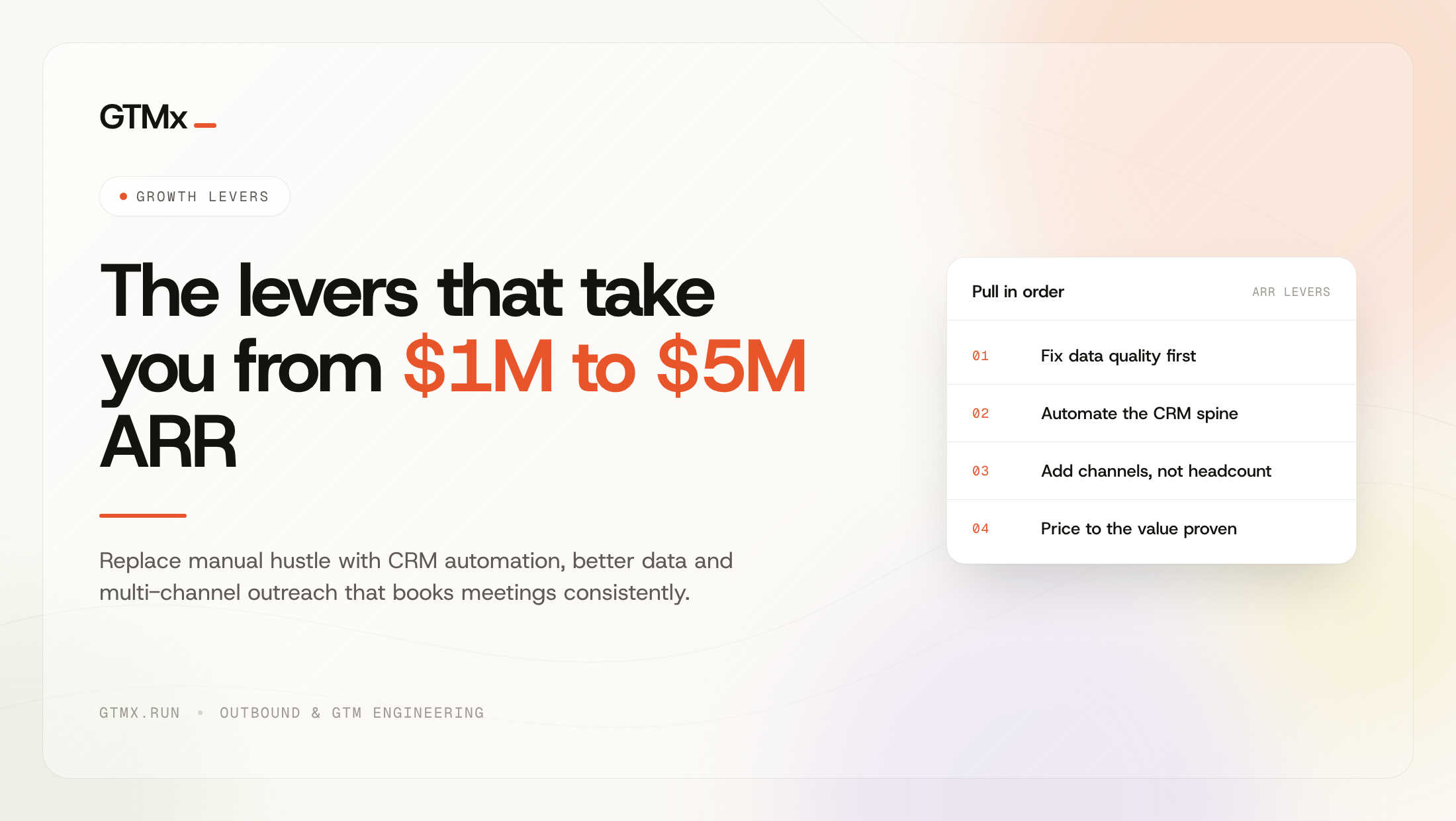
Reaching $5M ARR requires revenue growth levers that replace manual hustle with strict CRM automation. Upgrading your data and multi-channel outreach creates a scalable engine that books meetings consistently.
TL;DR Reaching $5M ARR requires revenue growth levers that replace manual hustle with strict CRM automation. Upgrading your data and multi-channel outreach creates a scalable engine that books meetings consistently.
Scaling past the first million breaks early sales playbooks. You must shift from manual hustle to strict operations and signal-led outbound systems. This blueprint explains what revenue growth levers you need to pull to build a lasting outbound engine.
Key takeaways
- Scaling past $1M ARR requires fixing your data and CRM before you hire new sales reps.
- Multi-source waterfall enrichment stops data decay by checking multiple providers before you send cold emails.
- Google enforces a strict 0.3 percent spam limit, making inbox deliverability management a vital task.
- Multi-channel outbound sequencing yields more meetings than single-channel email outreach by reaching buyers everywhere.
- Native CRM AI agents handle automated lead routing without adding friction for corporate buyers.
- Raising your net revenue retention slightly improves your baseline growth rate for scaling software firms.
What revenue growth levers matter most at the first million?
Scaling past a million requires automated CRM orchestration to replace your founder sales effort. This technical leap breaks most early business models.
1. Structural operational shifts
Manual founder sales break down fast. Raw hustle cannot scale past early deals. Your staff burns out quickly without structural support.
Replacing physical effort with rigid technical systems maintains growth. You must implement a strict CRM hierarchy so operations run smoothly.
Moving past this barrier requires specific metrics that automate follow-ups. See why your sales playbook will not scale.
2. Data before sales leadership
Reps need good data to win consistently. Founders often think a senior leader fixes bad pipeline issues. New hires simply inherit a broken process when data is poor.
Setting clear data verification rules ensures your team can execute their outreach.
Half of first sales hires leave within two years. Our guide explains the 250k mistake hiring vp sales first.
3. Automated lead routing
Basic sales tactics fail at volume. Relying on manual qualification creates bottlenecks that trap your pipeline velocity.
A strict operational system routes leads directly to the right account executive. You build a rigid framework that manages contact details autonomously.
Running multi-source data checks acts as the foundation for your scaling engine.
4. Technical GTM engineering
Hard technical work leads directly to a sales floor that runs without interruption. Perfect data sourcing removes the heavy lifting that distracts your team.
We wire these platforms together so contact details flow perfectly into your CRM.
GTMx builds waterfall TAM lists in Clay and can have pre-warmed inboxes live in 72 hours.
How do you build revenue growth levers with waterfall enrichment?
Replacing bought lists with multi-source waterfall enrichment targets real buying signals. This critical step stops contact decay and saves your sales team valuable time.
5. Multi-source contact verification
Constant data decay drives up costs for warehouse coworking spaces. Using one provider causes massive waste because bounced emails force your team to chase bad leads.
Layered checking ensures you only contact valid addresses.
B2B contact data decays steadily, which directly harms your sales efficiency metrics. Re-verify lists before every campaign.
6. Layered intent profiling
Generic outreach yields terrible response rates. Relying purely on demographic details leaves you pitching cold prospects who have no immediate need.
Waterfall enrichment searches until it finds an active email. It layers intent data to build profiles based on funding and hiring news.
You see this wired directly into our scalable operations.
7. Signal-led outbound targeting
Reaching out blindly wastes your limited addressable market. Modern sales requires precise timing to turn a cold pitch into a relevant conversation.
You configure your data stack to alert reps the moment a prime signal occurs.
Tools like UserGems show how tracking these signals creates CRM opportunities. Our B2B scaling blog explains this deeply.
Why is inbox deliverability management a vital revenue function?
Inbox placement is a hard technical barrier requiring strict SPF, DKIM and DMARC alignment. Good inbox deliverability management protects your pipeline from failing completely.
What is an acceptable spam complaint rate in Google Postmaster Tools for cold outreach?
Google enforces a strict 0.3 percent spam complaint threshold for bulk senders. Staying below this hard limit requires highly targeted outreach.
Domains crossing this mark face severe throttling and reduced inbox placement. This deliverability failure directly harms your pipeline generation efforts.
How do you set up secondary domains for outbound?
Sending from a primary domain puts your main communication lines at extreme risk. Proper inbox deliverability management keeps campaigns out of the spam folder.
We register new domains that redirect to your site.
GTMx registers secondary domains that redirect to the client's own website to protect primary sender reputation.
How do Microsoft Exchange limits affect sending?
Blasting thousands of emails from a standard account pauses operations instantly. You cannot run a scalable outbound engine this way if you want consistent meetings.
Microsoft Exchange Online enforces a rolling limit of 10,000 recipients per mailbox every 24 hours and is not designed for bulk email (Microsoft).
You must rotate multiple mailboxes and watch daily limits closely.
How do you write copy that avoids spam filters?
Complex HTML and tracking pixels trigger corporate spam filters. Stripping messages down to plain text ensures they reach the primary inbox reliably.
We write short cold email sequences that stay under 75 words. We pair them with AI search optimization to capture intent.
This concise format evades strict filters.
How does automated CRM orchestration speed up sales cycles?
Using revops automation speeds up lead routing instantly. It handles inbound intent without needing junior staff to qualify deals manually.
8. Fast lead qualification
Automated routing removes all human delay from the qualification phase. Forcing buyers through clunky chatbot menus delays the sales cycle.
These systems process incoming information accurately to map intent signals. You must deploy native AI workflows from HubSpot and Salesforce to triage inbound leads.
This speed maximizes your conversion probability.
9. Structured deal stage tracking
Growing companies must move from unstructured guesswork to strict deal stages. Documented stages dictate exactly what actions a rep must take.
Operations teams must manage a shift to strict CRM rules to keep the floor aligned.
Companies like Chili Piper and sports marketing agency opensponsorship achieved rapid scale this way.
10. Dormant account alerts
Strict pipeline hygiene prevents stalled opportunities from artificially inflating your projections. Clean data helps your sales team focus on winnable deals.
Automated notifications prompt reps to follow up precisely when a deal stalls.
You configure the best revops levers for scaling to flag stuck deals before they rot.
Expanding Net Revenue Retention And Seat Volume
Finding new logos costs more than expanding existing accounts. Building triggers for net revenue retention creates a compounding effect on your baseline ARR.
What are the SaaS growth levers $1M to 5m compared?
| Growth Lever | Primary Focus | Implementation Difficulty |
|---|---|---|
| Inbound Orchestration | Speed to lead | Moderate |
| Waterfall Enrichment | Contact data accuracy | High |
| Automated Account Expansion | Net revenue retention | High |
| Intent-based Outbound | Pipeline acceleration | High |
Choose inbound orchestration if you have high organic traffic. Opt for intent-based outbound if you need immediate targeted meetings.
How do you track product usage triggers?
Routing product signals to sales creates a reliable upselling path. Reps call clients precisely when engagement peaks. This naturally expands account value without aggressive pitching.
You do this by tracking in-app usage triggers showing a customer needs more seats.
Raising your growth rate is possible by shifting retention upwards, because expansion revenue is cheaper than new acquisition.
How do you build an automated renewal statement of work?
Generating paperwork manually creates administrative friction for growing businesses. Automation protects your existing client relationships from manual errors.
Building an automated renewal statement of work in your CRM solves this problem permanently.
It replaces frantic referral chasing with a structured path for busy account managers.
What is a good gross revenue retention benchmark?
If retention drops below standard industry marks, no pipeline acceleration levers will save your business. Keeping current customers happy funds future expansion.
Hitting this target requires onboarding flows driving immediate use.
Track gross and net revenue retention against peers at your ARR stage, and fix churn before you scale acquisition.
Automate Your Pipeline Data With RevOps
See how GTMx wires Clay and 200+ data providers into HubSpot or Salesforce so sourcing, enrichment, scoring and routing run themselves, delivered in 30 to 60 days with full documentation.
Multi-Channel Outbound Sequencing Strategies
Combining email, LinkedIn and warm calling yields more qualified meetings. This captures buyers on their preferred platform at the right time.
11. Targeted LinkedIn connection requests
Targeting job-change signals yields direct messaging conversations that convert efficiently. You filter your audience down to active users who regularly post.
We rewrite profiles for replies before sending targeted LinkedIn outreach messages to prospects showing strong intent.
LinkedIn outreach yields meetings if you respect the limits on your account. LinkedIn does not publish an official weekly invitation cap, and practitioners commonly observe about 100 connection requests per week.
12. Triggered same-day calls
Immediate contact almost always means a highly relevant conversation. You set up CRM alerts that notify your reps the moment a prospect interacts.
GTMx runs triggered warm calling campaigns based on email opens, link clicks and replies.
This multi-channel outbound sequencing captures engaged buyers immediately.
13. Synchronized live dashboards
Transparency ensures your team has clear control over the campaign strategy. Connecting all your sending platforms via APIs ensures every interaction logs centrally.
You must implement strict data syncing into HubSpot or Salesforce. We provide a shared live dashboard tracking daily reply data.
This setup makes accessing centralized platform data easier.
Where Early Revenue Growth Levers Usually Break Down
Scaling causes operational stress that exposes weak data and compliance gaps. You must spot these failure modes early to avoid massive wasted spend.
14. UK GDPR compliance workflows
Failing to manage consent properly exposes your company to severe regulatory action. Direct marketing to UK corporate buyers does not need prior opt-in under PECR.
Processing data must meet UK GDPR rules (ICO, 2026). You embed clear unsubscribe links across all integrated platforms.
This makes a compliance review essential.
15. Cost recovery monitoring
Efficient growth requires balancing your upfront costs against long-term customer value. Tracking the time it takes to recoup initial sales costs dictates how aggressively you can invest.
You must calculate your recovery metrics closely.
The median CAC payback period benchmarks for private B2B SaaS businesses sit at 16 months (Aleph and Benchmarkit, 2026).
16. New ARR acquisition budgeting
Ignoring the true cost of new revenue destroys profitability in highly competitive sectors. Shifting focus toward account expansion offsets the rising price of generating net new logos.
You must balance external acquisition with strong internal retention strategies.
Recent data shows a median spend of $1.30 to generate just $1.00 of new ARR (Aleph and Benchmarkit, 2026).
17. HTML code stripping
Deliverability drops drastically when email providers detect heavy styling. Sending high-volume campaigns filled with complex code destroys your domain reputation quickly.
Formatting your templates as plain text makes them look like manual emails.
In GTMx's Vidify case study, removing open tracking and cutting images and HTML improved deliverability, and the campaigns generated 54 opportunities in one month.
How should you sequence your B2B revenue growth levers?
Building these revenue growth levers out of order leads to bad technical debt. You need to align your data foundation before adding multi-channel automation.
How do you audit your current GTM stack?
Consolidating your software saves money and reduces technical debt immediately. A clean CRM speeds up daily operations and prepares your company for advanced automation.
You must strictly audit your CRM and data providers to find duplicate records.
Fixing these broken workflows establishes a solid technical base for scale.
How do you calculate your rule of 40 score accurately?
Burning cash blindly destroys the company. Efficiency metrics remain critical for survival.
The calculation combines your growth rate and profit margin: Growth Rate (%) + Profit Margin (%). A total of 40 or more is the common threshold for a healthy score.
A healthy Rule of 40 score shows your business balances growth and profit well, so track growth and margin together.
How do you deploy pipeline acceleration levers?
Keeping momentum high throughout the sales cycle turns pipeline into closed revenue faster. Strong pipeline acceleration levers shrink the time between a first meeting and a closed deal.
You achieve this by segmenting campaigns by lead score.
Deploying these focused campaigns generates leads quickly and stops warm prospects from going cold.
What is the checklist for your first automated engine?
- Define your total addressable market parameters clearly.
- Register three secondary domains for outbound sending.
- Set up SPF, DKIM and DMARC DNS records.
- Connect your domains to a dedicated sending tool.
- Build a multi-source waterfall enrichment data workflow.
- Draft plain, human-written emails under 75 words.
- Clean and formalize your CRM deal stages.
- Launch email sequences to a tiny test batch.
- Watch daily spam complaint rates in Google Postmaster.
- Trigger same-day warm calls based on email engagement.
Find Your First Qualified Pipeline Fast
A free 30-minute GTM audit that maps where your first qualified pipeline would come from, with no pitch. Josh reviews your current motion, your addressable market and the gaps between them.
Frequently asked questions
When should a founder hire a Head of Sales vs a RevOps lead?
Founders should hire a RevOps lead first to establish data hygiene, CRM rules and automated lead routing. Bringing in a Head of Sales without these operational systems leads to high staff turnover and wasted ad spend. Reps need a scalable framework to execute their pipeline generation tasks effectively.
How do we set up DKIM, SPF, and DMARC without breaking transactional emails?
You must register entirely new secondary domains for your cold outreach campaigns. Configure SPF, DKIM and DMARC on these new domains and redirect them to your main website. This setup isolates sender reputation risks. It protects your main business operations from severe email marketing damage permanently.
What is the difference between RevOps and GTM Engineering at the $2M ARR stage?
RevOps manages internal sales processes, tracks metrics and maintains existing CRM rules smoothly. GTM engineering takes a deeply technical approach. Engineers actively build multi-source data waterfalls and wire autonomous AI agents. They set up the complex technical tools needed to launch signal-led outbound campaigns effectively across multiple platforms.
How do we route high-intent website visitors directly to AEs?
You route high-intent visitors instantly by using CRM-native AI agents. These tools enrich inbound form fills with rich company data in seconds. They score the account fit immediately and assign the lead to an account executive. This cuts manual triage delays and improves your speed to lead dramatically.
How many sales reps can a single RevOps specializt support at $3M ARR?
A trained RevOps specializt using modern GTM engineering tools can support ten to fifteen active sales reps. By automating manual prospecting, data enrichment and deal stage tracking, the specializt removes heavy admin tasks. Reps can then dedicate their time entirely to closing qualified deals faster.
What intent signals have the highest conversion rate for enterprise B2B sales?
Job changes among past customer champions and fresh funding rounds represent the strongest intent signals. Tracking these triggers lets your team reach buyers exactly when they have new budgets or mandates for change. This easily outperforms generic outreach campaigns that target static lists with low conversion rates.